
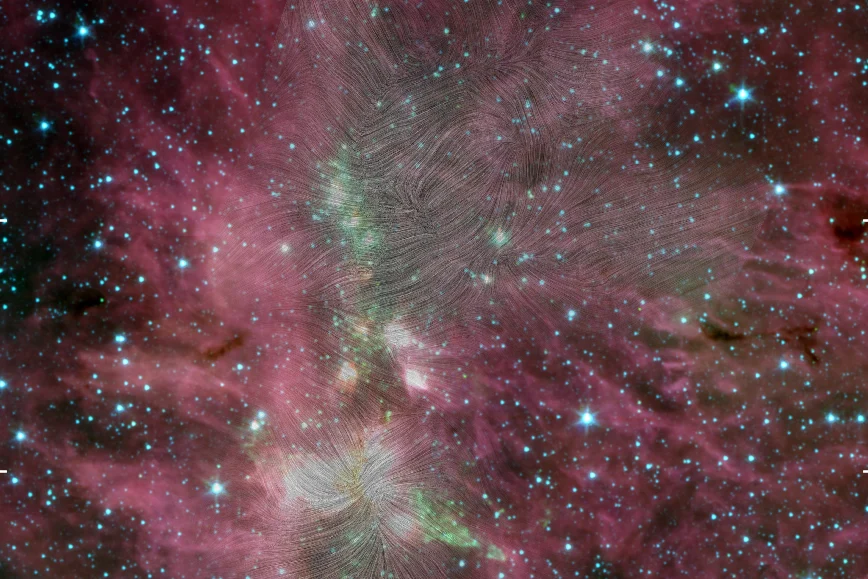
A team of astronomers from MIT Haystack Observatory has created the most detailed map yet of the magnetic fields threading through DR21, a region of intense star formation about 5,000 light-years from Earth. Published in The Astrophysical Journal, the research reveals that these invisible magnetic structures act as conduits, channeling gas toward the dense central filament where massive stars are born.
What Happened
Using polarization data from the now-retired SOFIA observatory, the researchers traced the magnetic field lines from DR21’s Main Ridge—a 13 light-year-long filament holding approximately 20,000 solar masses of cold molecular gas—out into the surrounding sub-filaments that feed material inward. The study, led by Thushara Pillai at MIT Haystack Observatory, confirmed that the magnetic fields do not simply reside within the cloud but actively guide the flow of gas inward. This magnetic scaffolding effectively funnels gas along the so-called “railroad tracks” of the field toward the central ridge, facilitating star formation over timescales of about one million years.
Key Facts
The study, published in The Astrophysical Journal on an open-access basis, utilized data from the Study of Interstellar Magnetic Polarization: a Legacy Investigation of Filaments (SIMPLIFI), an international collaboration involving over a dozen institutions. The team employed SOFIA’s far-infrared polarization data to map the spatially continuous magnetic field across DR21. This was enabled by advanced data reduction techniques developed by Jens Kauffmann and colleagues, overcoming significant technical challenges. The DR21 region lies within the Cygnus X complex, a prolific star-forming area of the Milky Way.
What This Means
This discovery clarifies a central question in astrophysics about how magnetic fields influence star formation. Instead of impeding gravitational collapse, the magnetic fields in DR21 shape the gas movement to accelerate efficient accumulation toward the cloud’s denser spine. This suggests that magnetic fields play an active, guiding role in star formation, acting not as an obstacle but as a framework that channels material into stellar nurseries.
Understanding this mechanism improves our ability to model how stars—and ultimately planetary systems—form in our galaxy and others. Since DR21 is representative of one of the most active nearby stellar nurseries, insights here may be generalized to broader star formation theories, potentially impacting fields such as galaxy evolution and cosmic structure formation.
The realization that previous measurements underestimated gas velocities due to the flow’s orientation in the plane of the sky also advances interpretations of observational data, emphasizing the necessity for multidimensional studies of these complex environments.
Background
Previous research had indicated the presence of filaments and gas inflows in DR21, but tracing the magnetic fields continuously from the dense ridge outward was not possible until SIMPLIFI utilized SOFIA’s unique far-infrared polarization capabilities. The Cygnus X complex, hosting DR21, is known for its luminous star-forming activity, but the role of magnetic fields in these environments remained debated.
What Remains Unclear
Despite these advances, aspects such as the precise strength of magnetic fields, their exact three-dimensional geometry, and how they evolve through different stages of star formation are not yet fully determined. The researchers also highlight the need to study fainter emissions and other clouds at varying evolutionary stages to fully understand magnetic influence across diverse conditions.
What Comes Next
The study’s team stresses the urgency of developing space-based far-infrared observatories with polarization measurement capabilities. With SOFIA’s retirement in 2022 and no planned replacement, future missions will be crucial for expanding detailed magnetic field maps beyond DR21 to a wider set of star-forming regions, thereby deepening insight into galactic star formation processes.
Sources
This article is based on reporting and publicly available information from the following sources:
Read more Science Discoveries stories on Goka World News.