
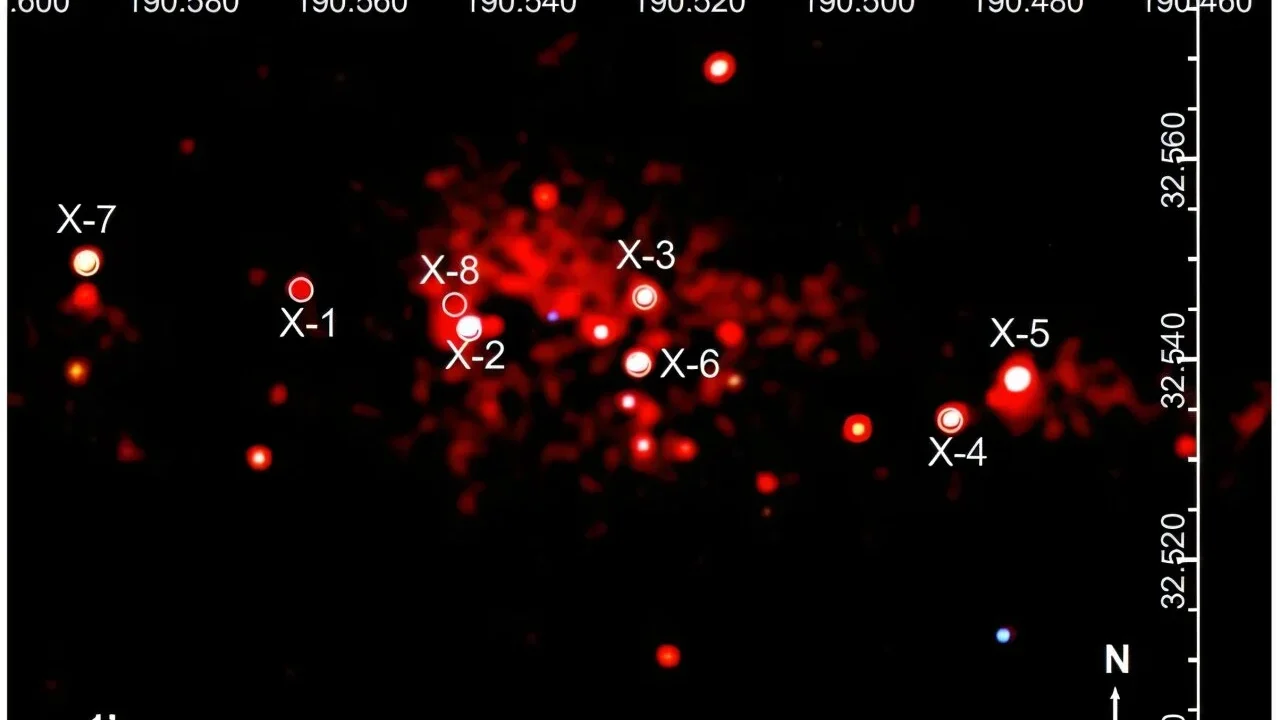
Astronomers from Germany and Turkey have conducted an in-depth analysis of the ultraluminous X-ray source (ULX) named X-4, located in the Whale galaxy (NGC 4631). Their study, published on June 22, 2026, on the preprint server arXiv, reports detailed observations of the source’s spectral and timing variability, offering new insights into the behavior of ULXs and their accretion processes.
What Happened
A research team led by Sinan Allak at the Institute for Astronomy and Astrophysics in Tübingen carried out the first dedicated spectral and timing study of X-4 through a comprehensive review of archival data from multiple space telescopes, including Chandra, XMM-Newton, and Swift/XRT. X-4 is positioned within NGC 4631, a star-forming spiral galaxy approximately 24.45 million light-years from Earth, known to host eight ULXs in total. Notably, X-4 is surrounded by an asymmetric bubble nebula, likely energized by jet- or outflow-driven shocks.
The study examined data spanning up to years, probing X-4’s variability from long-term trends down to fluctuations occurring within kilosecond intervals.
Key Facts
The research verified that X-4’s X-ray luminosity fluctuates extensively, varying by more than two orders of magnitude in the 0.3–10 keV energy band across the observational timeline, confirming its transient nature. Short-term observations revealed peak-like structures in the X-ray light curve, lasting between roughly 1,000 and 5,000 seconds, alongside non-periodic fluctuations. These features support a model where the emission is governed by a radiatively driven, optically thick wind.
Additionally, the relationship between X-4’s luminosity and temperature, along with the complex hardness evolution, diverged from expectations based on standard thin accretion disk theory. The data suggest super-Eddington accretion with effects from strong winds and differing viewing angles altering the observed spectrum.
No coherent pulsations, quasi-periodic oscillations, or statistically significant periodic signals were detected in the analyzed Chandra and XMM-Newton datasets. The findings imply that the compact accretor in X-4 is likely a stellar-mass object, consistent with either a neutron star or a stellar-mass black hole.
What This Means
This study highlights the dynamic and complex nature of ULXs, particularly those undergoing super-Eddington accretion, a regime where the accretion rate exceeds classical limits set by radiation pressure. The detailed spectral and timing analysis of X-4 suggests that interpreting ULX emissions requires models that incorporate optically thick winds and orientation effects, rather than relying solely on thin disk frameworks.
Understanding such sources is crucial because ULXs act as local laboratories for studying extreme accretion physics applicable to broader astrophysical contexts, including quasars and black hole growth in the early universe. The transient and highly variable behavior of X-4 underscores the importance of multi-epoch and multi-instrument observations to capture the full phenomenology of these exotic objects. This knowledge deepens insight into how mass transfer and feedback mechanisms operate in compact binary systems, which can inform models of stellar evolution and galaxy dynamics.
Background
ULXs are defined as point sources with X-ray luminosities exceeding a million times that of the sun across all wavelengths, yet less luminous than active galactic nuclei. While many ULXs have been detected and studied, their fundamental nature remains debated, with competing models involving stellar-mass black holes, neutron stars, and intermediate-mass black holes. NGC 4631, also known as the Whale galaxy, is recognized for its active star formation, which fosters environments conducive to the emergence of ULXs.
What Remains Unclear
The precise nature of the compact object powering X-4 remains undetermined. Although the data favor a stellar-mass accretor, distinguishing between a neutron star and a black hole requires observations with improved sensitivity and signal quality. Moreover, detailed modeling of the supercritical accretion flow structure and wind properties demands further empirical constraints.
What Comes Next
Researchers emphasize the need for future observations with deeper exposures and higher signal-to-noise ratios to refine the characterization of X-4’s compact object and accretion environment. Such data would also allow testing of wind geometry models and potentially reveal coherent pulsations, settling questions about the accretor’s identity.
Sources
This article is based on reporting and publicly available information from the following source:
Read more Science Discoveries stories on Goka World News.