
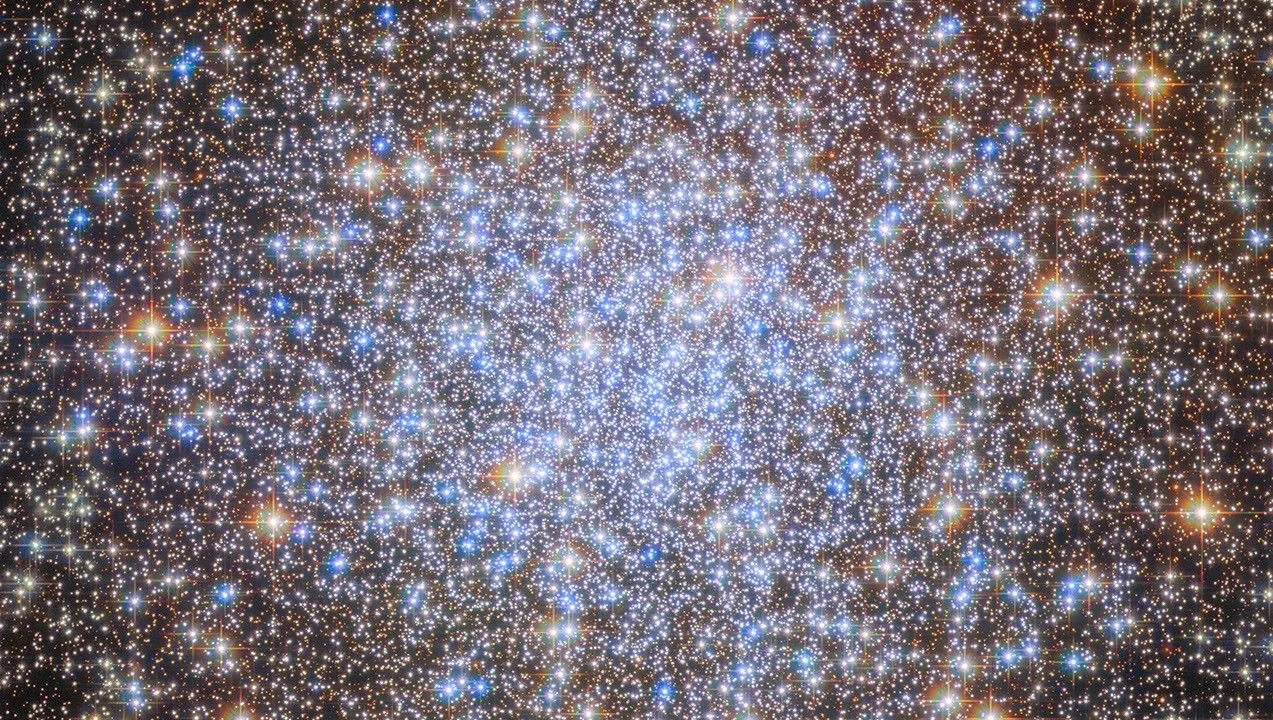
The Hubble Space Telescope, operated jointly by ESA and NASA, has released a striking image of the globular cluster NGC 6723, also known as the Chandelier Cluster. Located about 27,000 light-years away in the constellation Sagittarius, this cluster dazzles with countless stars that resemble sparkling lights in a giant celestial chandelier.
What Happened
On June 26, 2026, ESA and NASA unveiled a detailed image of NGC 6723 captured by the Hubble Telescope. This globular cluster is a dense spherical collection of stars, each visible as an individual point of light in the image. These stars are among the oldest in the Milky Way galaxy, providing a glimpse into the galaxy’s ancient past. The cluster resides within Sagittarius, the Archer constellation, and continues to be a subject of study to understand the early formation of stellar systems.
Key Facts
NGC 6723 lies approximately 27,000 light-years from Earth. It is a classical globular cluster, characterized by its high density and spherical shape. Many of the stars in this cluster are more than 10 billion years old, placing their formation close to the origin of the universe. The image was released by ESA and NASA, credited to scientists A. Sarajedini and G. Piotto, showcasing high-resolution data from Hubble’s instruments.
What This Means
The detailed imaging of NGC 6723 offers valuable insight into the formation and evolution of the Milky Way. Globular clusters like this one are among the earliest structures to emerge in the galaxy, predating the formation of the more familiar disk of stars that includes our Sun. Studying these clusters improves astronomers’ understanding of stellar population ages, the chemical evolution of galaxies, and the processes that shaped the early cosmos. For readers, it underscores how looking deep into the night sky is essentially a look back in time, revealing ancient components of our cosmic neighborhood.
Additionally, research on globular clusters challenges and refines models of galaxy formation by providing clues about how early stars assembled into more complex systems billions of years ago. The sparkle of NGC 6723 is not just a beautiful sight, but a key to unraveling galactic history.
Background
Globular clusters such as NGC 6723 are tightly bound systems containing hundreds of thousands of stars. Many globulars have ages approaching or exceeding 10 billion years, some potentially as old as the universe itself. Astronomers regard them as relics from the early stages of galaxy formation. Despite extensive study, the precise mechanisms behind globular cluster formation remain uncertain, with debates ongoing about whether they formed in situ within the Milky Way or were accreted from dwarf galaxies.
What Remains Unclear
While the age and stellar content of NGC 6723 are well established, the exact origins and formation timelines for globular clusters continue to be topics of ongoing research. Data from Hubble and other observatories contribute pieces to this puzzle, but comprehensive models explaining their diverse properties remain incomplete. Scientists are continuing to analyze observations to clarify these aspects.
Sources
This article is based on reporting and publicly available information from the following sources:
Read more Space & NASA stories on Goka World News.