
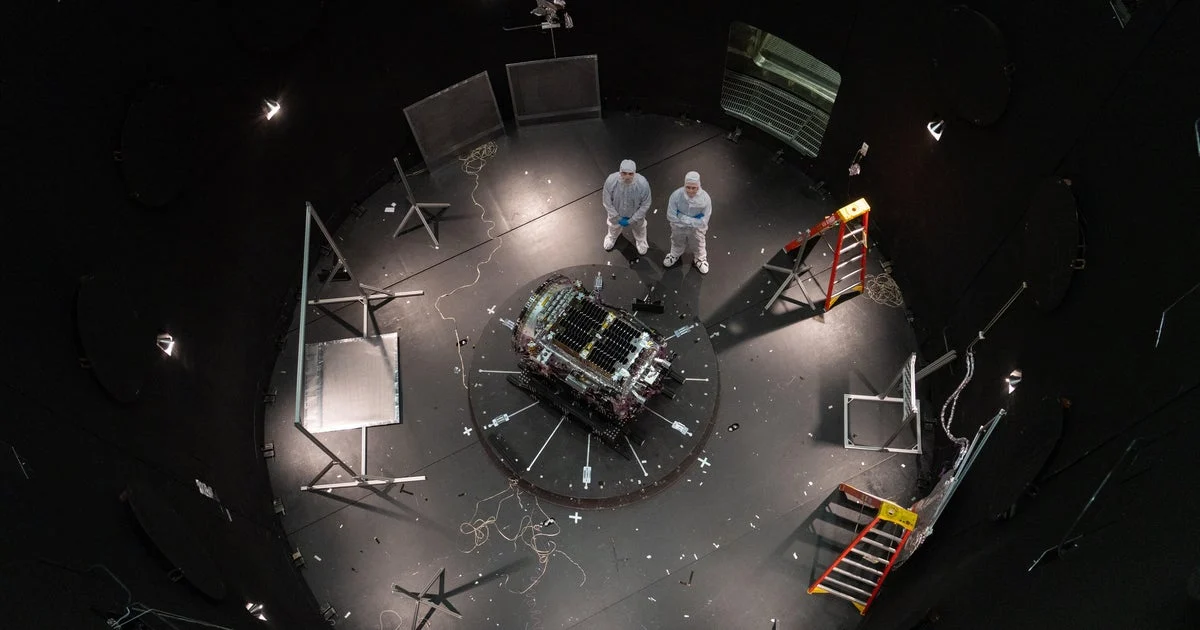
NASA is preparing a groundbreaking robotic mission to save the aging Swift Observatory from a rapid orbital decay that threatens to bring the telescope back to Earth prematurely. The rescue operation, contracted to startup Katalyst Space Technologies, aims to boost Swift to a higher, stable orbit where it can continue its vital role in capturing cosmic explosions such as gamma ray bursts.
What Happened
The Swift Observatory, launched in 2004, has suffered accelerated orbital decay due to recent intense solar activity. NASA plans to launch an autonomous spacecraft called Lift, developed by Katalyst, as early as this week from the Marshall Islands aboard a Pegasus rocket. The robotic craft will take about a month to rendezvous with Swift at its current altitude of approximately 224 miles (360 kilometers) and will use its three articulated arms equipped with pinching grippers to grasp and elevate the observatory’s orbit to about 373 miles (600 kilometers). This altitude boost is critical as Swift is expected to cross the “point of no return”—below 185 miles (300 kilometers)—by October, after which it would reenter Earth’s atmosphere.
Key Facts
The $30 million mission will lift Swift, a 1.6-ton gamma ray observatory with a 40-foot solar panel wingspan, out of its dangerously low orbit. Previously, NASA extended Swift’s operational lifespan by shutting down scientific instruments early this year to reduce drag, effectively slowing its descent. Swift has not conducted scientific observations since February.
This mission marks the first American robotic satellite servicing effort of its kind, following a similar 2018 Chinese mission that shifted a satellite to a graveyard orbit. Katalyst’s Lift spacecraft features three robotic arms with finger-like pincers designed to grip non-cooperative satellites not originally built for servicing.
The success of the Swift mission could pave the way for future rescues, including a potential boost for the iconic Hubble Space Telescope, which is also losing altitude due to solar activity and might require intervention by the late 2020s.
What This Means
Saving Swift carries significant implications for both astronomy and space operations. The telescope functions as NASA’s “first responder” to transient cosmic events like gamma ray bursts, enabling rapid observation of phenomena that other telescopes, such as the James Webb and soon-to-launch Roman Space Telescope, are expected to discover in increasing numbers. Without this mission, the loss of Swift would create a gap in real-time alert capabilities for high-energy cosmic events.
The mission also represents a critical advancement in satellite life extension and space sustainability. By proving the feasibility of robotic orbit-raising maneuvers, NASA and Katalyst are pioneering a new paradigm in on-orbit servicing, potentially reducing the need to build costly replacement satellites. This approach could inspire a future industry of autonomous spacecraft performing repairs, refueling, and assembly tasks, extending the lifetime and capabilities of existing space infrastructure.
For the broader scientific community and public, preserving assets like Swift and potentially Hubble maintains continuous access to important astronomical data that enriches understanding of the universe and drives advances in astrophysics.
Background
Swift has operated for 22 years, far beyond its originally planned mission lifetime. Its accelerated orbital decay is driven by increased solar flares and charged particle activity that expand Earth’s atmosphere and increase drag on low-orbit spacecraft. Traditional servicing missions, such as those that extended Hubble’s life, relied on astronauts during the Space Shuttle era but ceased after the shuttle’s retirement.
Katalyst Space Technologies was awarded the contract in September 2025 with a directive to conduct a rapid but risk-averse mission. The robotic Lift spacecraft embodies new space-industry ambitions to develop autonomous servicing capabilities for satellites in low Earth orbit and eventually geostationary orbit.
What Comes Next
If successful, the Lift mission could conclude Swift’s orbit raise by September 2026, restoring the telescope’s operational capabilities. NASA is also evaluating potential similar missions targeting Hubble, projected for as early as 2028.
Katalyst plans to advance its technology with a larger, next-generation servicing robot scheduled for launch next year to work with satellites at geostationary orbit (about 22,300 miles altitude). These developments herald a growing commercial sector dedicated to satellite life extension and orbital servicing.
Sources
This article is based on reporting and publicly available information from the following sources:
Read more Space & NASA stories on Goka World News.