
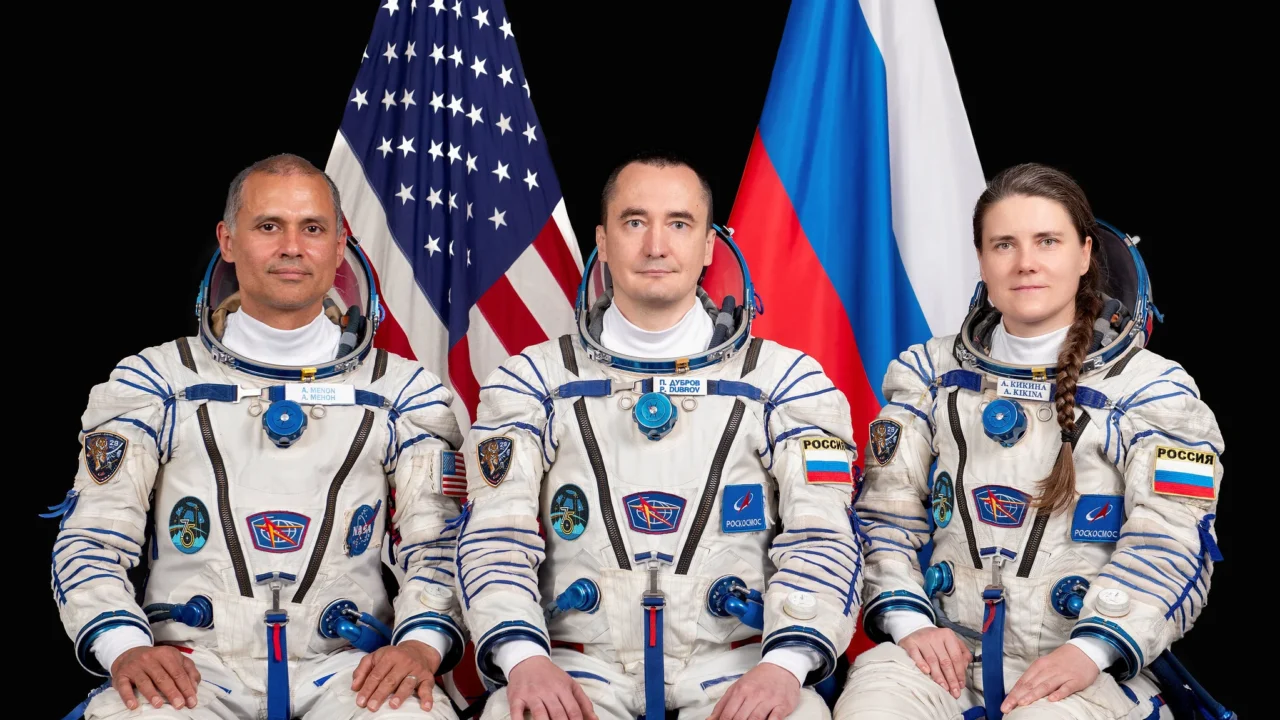
NASA astronaut Anil Menon is scheduled to launch to the International Space Station (ISS) on July 14, aboard the Roscosmos Soyuz MS-29 spacecraft. The launch, confirmed by NASA, will mark Menon’s first spaceflight as he joins cosmonauts Pyotr Dubrov and Anna Kikina for an approximately eight-month mission focused on scientific research and technology demonstrations.
What Happened
Menon, along with Dubrov and Kikina, will lift off at 10:47 a.m. Eastern Daylight Time (EDT) from the Baikonur Cosmodrome in Kazakhstan. The spacecraft will undertake a two-orbit, roughly three-hour journey to the ISS, docking automatically at 1:56 p.m. EDT to the station’s Prichal module. Following docking, the hatches will open for the three new crew members to enter the orbital laboratory and join the existing Expedition 74 crew onboard.
The expedition crew currently includes NASA astronauts Jessica Meir, Jack Hathaway, and Chris Williams; ESA astronaut Sophie Adenot; and Roscosmos cosmonauts Sergey Kud-Sverchkov, Sergei Mikaev, and Andrey Fedyaev. Menon, Dubrov, and Kikina will then remain aboard the station until April 2027 as part of Expeditions 74 and 75 before returning to Earth.
NASA has arranged live coverage of the launch, docking, and hatch opening via NASA+, Amazon Prime, and the agency’s YouTube channel, providing public access to this significant mission milestone.
Key Facts
- The launch is set for July 14, 10:47 a.m. EDT from Baikonur Cosmodrome, Kazakhstan.
- The spacecraft involved is Roscosmos Soyuz MS-29.
- Docking with the ISS’s Prichal module is scheduled for 1:56 p.m. EDT.
- Mission duration aboard the ISS is expected to be approximately eight months, ending in April 2027.
- Menon’s mission is his first spaceflight; Dubrov and Kikina have flown once before.
- The public can watch the launch and docking live on NASA+, Amazon Prime, and NASA’s YouTube channel.
- The crew will join Expedition 74 and later Expedition 75 on the ISS.
What This Means
This mission highlights the continuing international partnership aboard the ISS, with U.S., European, and Russian astronauts collaborating to advance space science and technology. Anil Menon’s first mission will focus on pioneering research critical to future deep-space exploration, including refining semiconductor crystal production in microgravity for advanced computing and AI applications. This work could significantly impact technology development on Earth.
Moreover, Menon’s experiments involving augmented reality and artificial intelligence for medical ultrasound aim to develop autonomous healthcare capabilities in space, reducing reliance on Earth-based medical support—a vital step for long-duration missions to the Moon or Mars. His role as a test subject investigating blood flow and bioprinting vascular constructs in microgravity may offer insights into human aging and new therapeutic technologies.
In practical terms, these experiments contribute not only to space exploration goals but also hold potential benefits for medicine and manufacturing that could eventually improve everyday life and health outcomes on Earth.
Background
For more than 25 years, the ISS has hosted continuous human presence in orbit, enabling research impossible on Earth. The station serves as a testbed for overcoming challenges related to long-duration spaceflight and advancing commercial opportunities in low Earth orbit. It also forms a foundational stepping stone for NASA’s Artemis program and future missions targeting the Moon and Mars.
What Comes Next
Following docking and hatch opening, Menon and his colleagues will begin their mission activities, which include scientific research and technology demonstrations aimed at extending human presence beyond Earth orbit. NASA’s live coverage will continue through key events in the initial mission phases.
Sources
This article is based on reporting and publicly available information from the following sources:
Read more Space & NASA stories on Goka World News.