
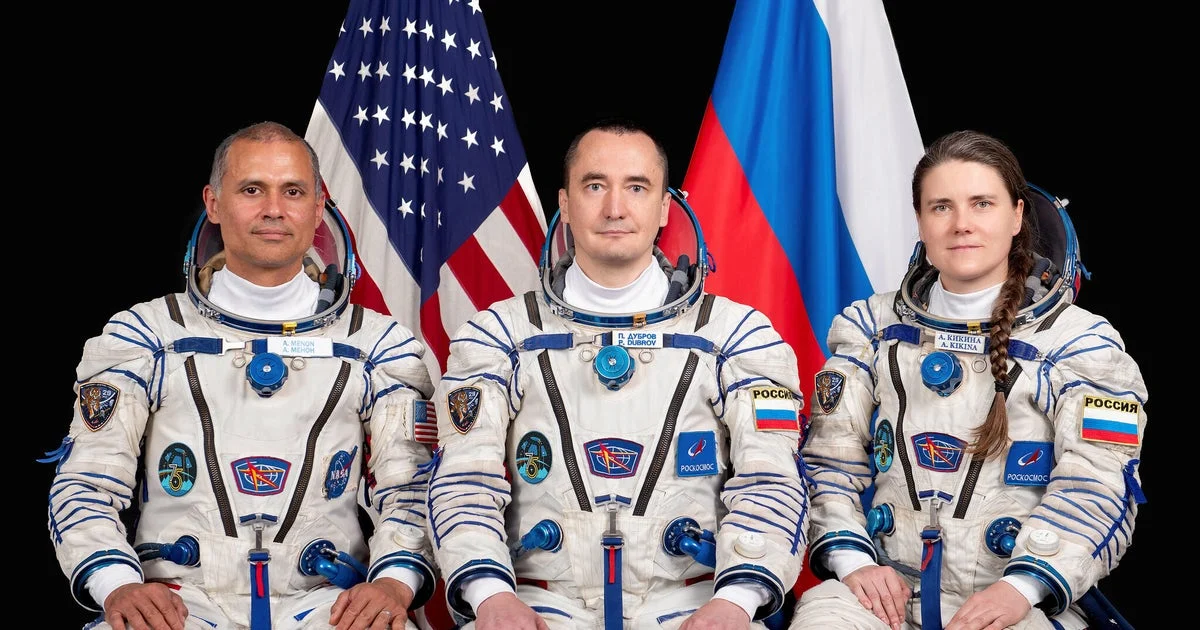
A Soyuz rocket carrying NASA astronaut Anil Menon and two Russian cosmonauts launched from Kazakhstan on July 14, beginning an eight-month mission aboard the International Space Station (ISS). The crew successfully docked with the station after a rapid, two-orbit rendezvous, continuing a longstanding partnership between NASA and Roscosmos for crewed spaceflight operations.
What Happened
The Soyuz MS-29/75S spacecraft lifted off from Baikonur Cosmodrome in Kazakhstan at 10:47 a.m. EDT on July 14, 2026. The crew aboard included Soyuz commander Pyotr Dubrov, cosmonaut Anna Kikina, and NASA astronaut Anil Menon. After an eight-minute, 46-second ascent, Soyuz separated from its booster and autonomously navigated the short, two-orbit journey to the ISS, docking at 1:52 p.m. EDT at the Russian Prichal module, which faces Earth.
Menon, making his first spaceflight, has a background as a NASA flight surgeon and SpaceX’s first flight surgeon before rejoining NASA’s astronaut corps in 2021. His fellow crew members, Dubrov and Kikina, are experienced Russian cosmonauts with prior spaceflight history. Anna Kikina previously flew aboard a SpaceX Crew Dragon mission in 2022.
The crew was greeted onboard by the prior Soyuz MS-28/74S team and other station members, and the handover ceremony took place in the Russian Zvezda module. The new crew will remain aboard the ISS for about 260 days until April 2027, during which they will conduct scientific research and station maintenance.
Key Facts
The launch originated from Baikonur Cosmodrome, the long-standing cosmonaut training and rocket-launch facility in Kazakhstan. The spacecraft docked at 260 miles above Earth, over the Mediterranean Sea. This marks an extension from the traditional five-to-six-month missions to an eight-month stay, aimed at reducing the frequency and cost of cargo shipments. The Soyuz spacecraft’s manual override systems remained on standby during the automated docking, but the spacecraft required no manual intervention.
Anil Menon and his wife Anna, also an astronaut in training, both worked professionally at NASA and SpaceX before joining NASA’s astronaut corps. Their family attended the launch at Baikonur, alongside NASA Administrator Jared Isaacman, who communicated directly with the crew after docking.
A longstanding exchange agreement between NASA and Roscosmos ensures at least one NASA astronaut flies aboard Soyuz and one Russian cosmonaut flies aboard SpaceX’s Crew Dragon, maintaining continuous operation and emergency readiness aboard the ISS.
What This Means
This successful launch and docking underscore the continued international cooperation essential for maintaining the ISS, which serves as a critical platform for scientific research, technology demonstration, and space experimentation. The extension to eight-month missions reflects evolving approaches to optimize station operations by limiting logistics demands and increasing crew stability for ongoing experiments.
Beyond the technical aspects, Menon’s journey highlights the diverse expertise and career paths feeding into the astronaut corps, illustrating how roles in medical support and commercial spaceflight contribute to human space exploration. His experience also emphasizes the complex personal challenges faced by astronaut families during extended missions, offering new insights into the social dynamics of space travel.
For the broader public, this mission continues to ensure that the ISS remains a hub for discoveries that can directly benefit life on Earth, including medical research and climate science, while advancing human spaceflight capabilities for future long-duration missions to the Moon and Mars.
The Bigger Picture
The Soyuz MS-29 crew swap occurs amid ongoing collaboration between NASA and international partners, including the European Space Agency and Roscosmos, which together oversee one of the most ambitious and enduring multinational projects in history. This mission’s lengthened duration aligns with efforts to prepare for deeper space missions by simulating longer habitation times in orbit.
Sources
This article is based on reporting and publicly available information from the following source:
Read more Space & NASA stories on Goka World News.