
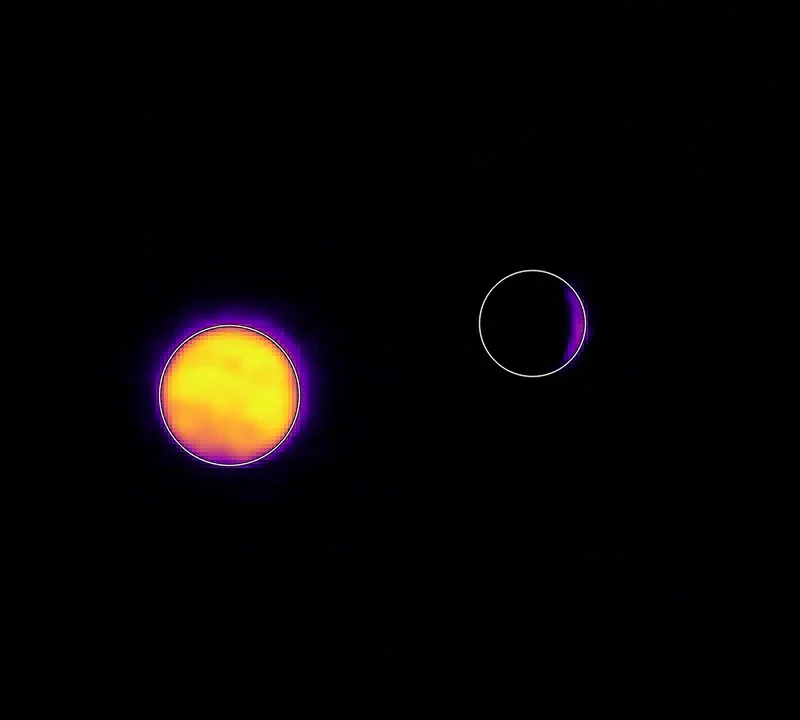
NASA’s ESCAPADE mission has successfully captured striking images of Earth and the Moon from deep space using visible and thermal infrared light. Taken on July 3, 2026, these photos served as crucial calibration tests for the spacecraft’s cameras before its scheduled journey to Mars.
What Happened
On July 3, 2026, one of the twin ESCAPADE (Escape and Plasma Acceleration and Dynamics Explorers) spacecraft, designed to study solar wind interactions with Mars, photographed Earth and the Moon from a vantage point approximately one million miles from Earth at the Lagrange point 2. The spacecraft was positioned 363,250 miles (584,600 kilometers) from Earth and 115,600 miles (186,100 kilometers) from the Moon. The visible-light images show both celestial bodies as crescents lit by roughly 8% of the Sun, with the Moon appearing relatively large due to its closer proximity.
Additionally, thermal infrared imaging revealed the Earth’s shadowed hemisphere glowing in heat emitted from its atmosphere and surface at temperatures between minus 10 to minus 44 degrees Fahrenheit (250 to 280 kelvins). In contrast, the Moon’s far side, lacking an atmosphere and oceanic insulation, appeared much colder at around minus 280 degrees Fahrenheit (100 kelvins).
Key Facts
- The ESCAPADE spacecraft was 363,250 miles (584,600 kilometers) from Earth and 115,600 miles (186,100 kilometers) from the Moon when the images were captured.
- Visible and Infrared Observation System cameras developed by Northern Arizona University took the photos.
- The images show Earth and the Moon as crescents under partial solar illumination—about 8% of their surfaces sunlit.
- Thermal infrared data highlighted Earth’s atmospheric and surface heat emissions, contrasting with the Moon’s much colder temperature.
- ESCAPADE is currently orbiting near Lagrange point 2, about one million miles from Earth.
- The mission is set to employ Earth gravity in November 2026 to slingshot the spacecraft to Mars, arriving in September 2027.
- ESCAPADE’s scientific goal is to study solar wind interactions with Mars and the planet’s atmospheric loss.
- The mission is funded by NASA’s Heliophysics Division under the Small Innovative Missions for Planetary Exploration program.
- Key partners include University of California, Berkeley (mission lead), Rocket Lab, NASA Goddard, Embry-Riddle Aeronautical University, Advanced Space, and Blue Origin.
What This Means
These images serve as more than visual milestones; they represent critical instrument calibration for the ESCAPADE mission’s cameras. Capturing well-understood targets like Earth and the Moon ensures that the spacecraft’s detection systems are operating accurately before they begin measuring less familiar phenomena at Mars.
Thermal infrared imaging of Earth’s own heat emissions provides insight into how ESCAPADE’s instruments will detect temperature variations on Mars, improving the quality and reliability of data about the Red Planet’s surface and atmosphere. This mission’s focus on solar wind interaction is vital to understanding atmospheric loss on Mars, a key factor in the planet’s climate evolution and habitability potential.
By accurately monitoring the solar wind’s effect, ESCAPADE will contribute to broader knowledge of planetary atmospheres and space weather, with implications for future human exploration and the protection of spacecraft and astronauts.
Background
The ESCAPADE mission consists of two identical spacecraft built by Rocket Lab, currently occupying a “loiter” orbit near the Earth-Moon Lagrange point 2. This stable gravitational zone allows them to await a convenient trajectory to Mars. The spacecraft are equipped with the Visible and Infrared Observation System, developed by Northern Arizona University, intended to detect Martian auroras and study thermal characteristics. The mission aligns with NASA’s initiative to leverage smaller, lower-cost spacecraft for innovative planetary science under the Small Innovative Missions for Planetary Exploration program.
What Comes Next
In November 2026, ESCAPADE will perform a gravity-assist flyby of Earth to propel itself towards Mars. The spacecraft are expected to arrive at the Red Planet by September 2027, where they will begin detailed studies of the solar wind’s impact on Mars’ atmosphere and environment.
Sources
This article is based on reporting and publicly available information from the following sources:
Read more Space & NASA stories on Goka World News.