
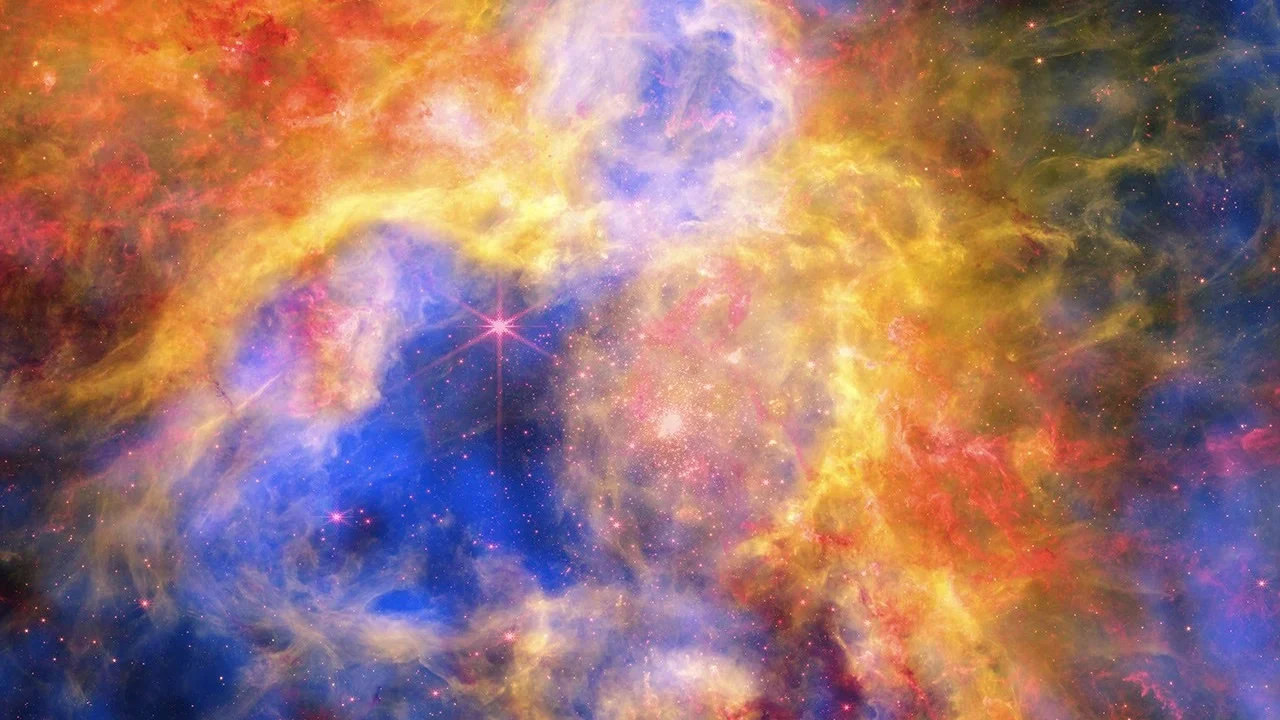
NASA’s trio of space observatories—Chandra X-ray Observatory, James Webb Space Telescope, and Hubble Space Telescope—have collectively produced a striking new composite image of the Tarantula Nebula, a star-forming region located in the Large Magellanic Cloud approximately 160,000 light-years from Earth. This colorful “cosmic craft” showcases the nebula’s complex structure and reveals fresh insights into how energy flows through this dazzling stellar nursery.
What Happened
The composite image combines X-ray, infrared, and optical observations collected by NASA’s flagship telescopes. The Chandra X-ray Observatory contributed data visualized in blue, capturing gas superheated to millions of degrees by shocks and winds from young, massive stars. Infrared details from the James Webb Space Telescope, shown in red, highlight thousands of newly formed stars and cooler dust clouds—the raw material for future star and planet formation. Hubble’s optical data appears in green, tracing the warmer hydrogen gas and revealing individual stars embedded within the nebula.
These multiwavelength datasets, including earlier infrared contributions from NASA’s retired Spitzer Space Telescope, were layered to produce a comprehensive view of the nebula’s dynamic environment. The resulting image was recently published in a research paper in the Astrophysical Journal by a team led by Jennifer Rodriguez of The Ohio State University.
Key Facts
The Tarantula Nebula, also known as 30 Doradus, lies in the Large Magellanic Cloud, a satellite galaxy of the Milky Way about 160,000 light-years away. The nebula contains thousands of young stars embedded in a honeycomb-like web of gas and dust. Chandra’s X-ray data reveals hot gas created by powerful stellar winds and shock waves, while Webb’s infrared imagery spots cool dust regions poised to birth new stars and planets. Hubble’s optical observations capture hydrogen gas at temperatures hotter than those Webb sees and provide sharp views of individual stars.
The study found significantly less X-ray-emitting hot gas than predicted by previous models of energy produced by stellar winds, suggesting that much of the energetic gas escapes or cools through mixing or conduction within the nebula. NASA’s Marshall Space Flight Center and the Smithsonian Astrophysical Observatory oversee Chandra operations, with scientific coordination managed from Cambridge, Massachusetts.
What This Means
This vibrant composite image advances our understanding of the complex processes governing star formation and energy distribution in one of the most active nearby stellar nurseries. By revealing where and how energy escapes or cools within the nebula, the research offers clues to the lifecycle of massive stars and the evolution of their surrounding environments.
For space enthusiasts and astronomers alike, this integrated view demonstrates the power of combining multiwavelength observations from different telescopes to unravel cosmic mysteries. It also illustrates how energy from young stars shapes and sculpts the interstellar medium, influencing future star and planet formation. This enhanced knowledge contributes to broader astrophysical models that explain the formation and behavior of galaxies, including our own Milky Way.
Background
Before this study, astronomers expected that the winds generated by young massive stars in the Tarantula Nebula would heat the surrounding gas enough to produce copious X-rays. The discrepancy between predicted and observed X-ray emission prompted scientists to explore alternative explanations for where the energy goes. By integrating data across X-ray, infrared, and optical wavelengths, the team identified energy loss mechanisms including gas escaping through shell boundaries, mixing between hot and cold gas, and heat conduction processes.
Analysis
Jennifer Rodriguez and collaborators analyzed data from NASA’s suite of space telescopes alongside computer simulations. Their findings suggest the nebula loses a substantial fraction of its hot gas energy, which escapes through gaps in the swirling gas shells or cools through direct thermal contact with colder materials. Unlike mixing that blends gases, conduction allows heat transfer without full intermingling, a process analogous to a frying pan warming on a burner.
What Comes Next
Further analysis of this rich dataset will refine understanding of the Tarantula Nebula’s energy dynamics and star formation processes. Continued observations from NASA’s telescopes are expected to provide more detail on how massive stars influence their environments and how such nebulae evolve over time.
Sources
This article is based on reporting and publicly available information from the following sources:
Read more Space & NASA stories on Goka World News.