
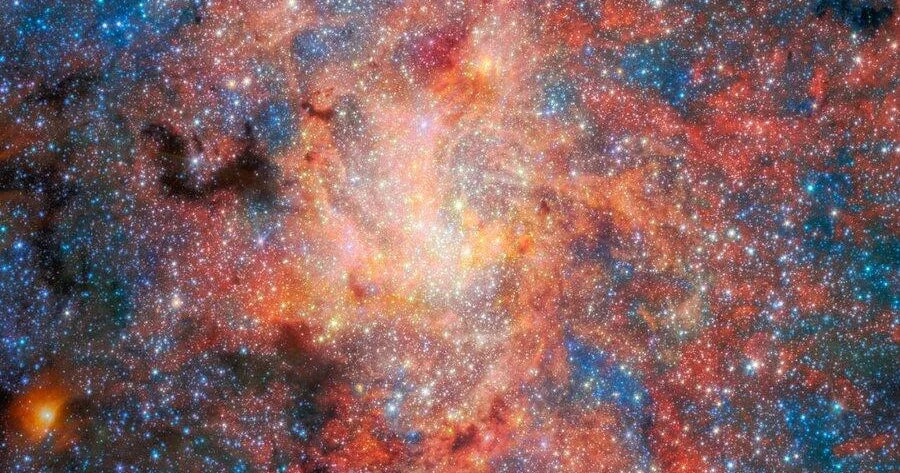
Astronomers have identified a new class of cosmic object dubbed a “black hole star,” which may explain peculiar bright red dots observed in the early universe. Detected by a U.S.-led team with the James Webb Space Telescope (JWST), this extraordinary entity emits about 100 billion times more energy than a typical star and dates back to roughly 660 million years after the Big Bang, researchers reported in the journal Nature.
What Happened
Since its commissioning in 2022, JWST has captured numerous ‘little red dots’—extremely luminous points in the distant universe that have puzzled scientists due to their intense brightness at an unexpectedly early cosmic epoch. The discovery of the “black hole star,” officially named MoM-BH*-1, was made as researchers analyzed these mysterious signals. Unlike traditional stars powered by nuclear fusion, MoM-BH*-1 radiates energy through a central black hole surrounded by a gas cocoon, making it appear star-like but vastly more energetic.
Key Facts
The team, led by Rohan Naidu from the University of Hawaii and involving researchers from MIT, noted several critical observations: the object’s extreme red hue is caused not by interstellar dust, as is common, but by hydrogen gas absorbing certain wavelengths. This absorption signature distinguishes it from dust-obscured light. The energy output of this object is approximately 100 billion times that of our Sun. The timing of its existence—660 million years after the Big Bang—places it among the earliest luminous sources detected by JWST. The discovery was made using advanced spectral data from the JWST, the most powerful telescope in operation.
What This Means
The identification of black hole stars offers a crucial piece in the puzzle of early universe evolution, particularly regarding the formation and growth of bright galaxies during cosmic infancy. These objects suggest a previously unrecognized energy source contributing to the intense luminosity seen at very high redshifts. For scientists, this could revise models of how black holes and galaxies co-evolved and how energy influenced early cosmic structures.
For the broader public and future research, this discovery expands our understanding of how extraordinarily energetic processes shaped the young universe. It also highlights the JWST’s capability to uncover phenomena that challenge traditional notions of star formation and black hole activity. The presence of such luminous entities might alter interpretations of galaxy surveys by distinguishing black hole star light from galactic emissions.
Background
The early universe, specifically within the first billion years after the Big Bang, has long been difficult to study due to the faintness and distance of objects from that era. Previously, astronomers expected limited formation of bright galaxies during this period, but JWST observations revealed more luminous galaxies than models predicted. The “little red dots” detected by JWST had raised questions about the nature of these sources. The current black hole star discovery offers an explanation for some of these bright signals, demonstrating that black holes surrounded by gas can mimic and exceed stellar brightness.
What Remains Unclear
While MoM-BH*-1 represents a compelling example, the overall population size and distribution of black hole stars remain unknown. Ongoing JWST surveys are expected to determine whether these objects are commonplace or rare phenomena. Additionally, the long-term impact of such objects on their host galaxies and the surrounding intergalactic environment requires further study, including how their radiation influences cosmic reionization phases.
What Comes Next
Researchers anticipate that more detailed observations with JWST and complementary telescopes will clarify the role of black hole stars in early cosmic history. Follow-up studies will focus on identifying additional candidates and analyzing their spectral and energy properties. These investigations may coincide with upcoming astrophysics conferences and JWST observation cycles aimed at probing the universe’s first billion years in greater depth.
Sources
This article is based on reporting and publicly available information from the following sources:
Read more Space & NASA stories on Goka World News.