
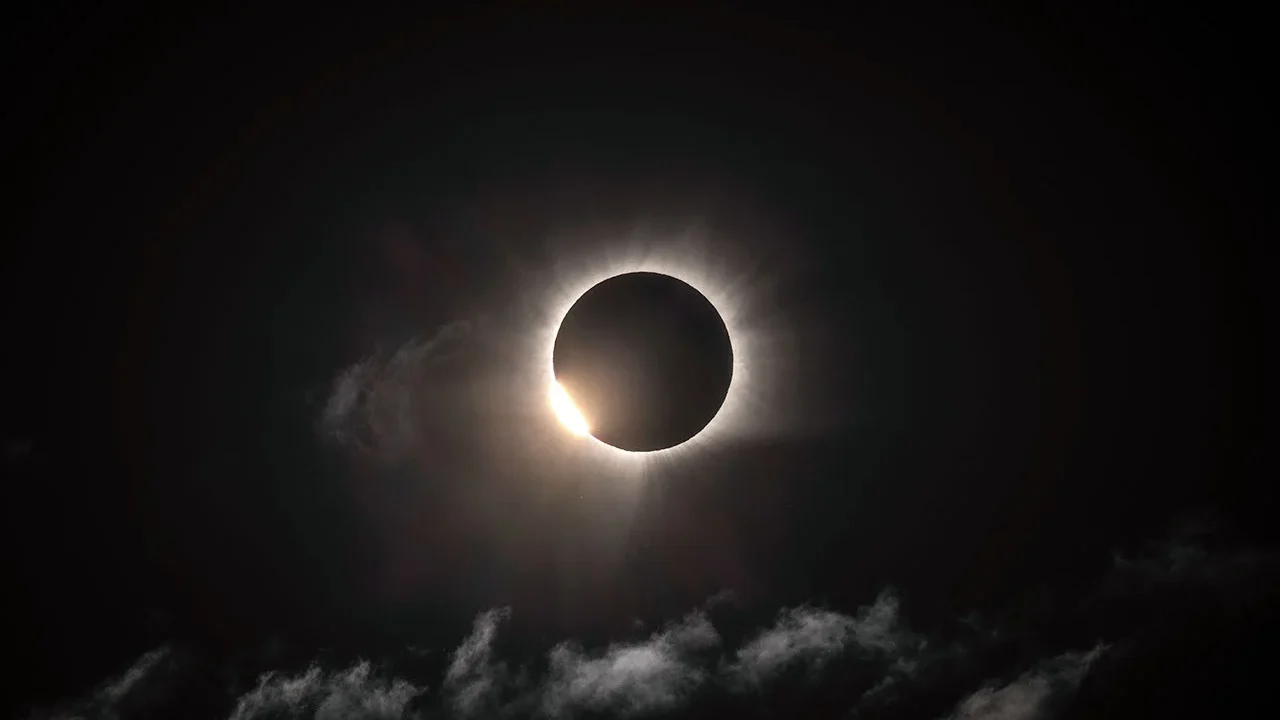
On August 12, 2026, the total solar eclipse’s shadow reached Earth, with the northernmost regions of Greenland witnessing clear, spectacular views of the event. This rare celestial alignment allowed observers to see the Moon fully obscure the Sun, revealing the solar corona and eclipse phenomena in dramatic fashion.
What Happened
The Moon’s shadow, or umbra, first touched Earth over the Arctic Ocean and traced a narrow path of totality crossing Greenland, Iceland, parts of the Atlantic Ocean, Portugal, and northern Spain on that day. The total solar eclipse was recorded near Rype Fjord on Greenland’s eastern coast at coordinates 71.07055°N, 27.71252°W, captured at 17:33:26 UTC. This image is believed to be among the earliest unobstructed views of totality during this eclipse. The observer managed to capture key eclipse features including a fleeting diamond ring effect—a bright flash of sunlight appearing just before totality—and the Sun’s corona glowing around the fully obscured solar disk.
Key Facts
The 2026 eclipse’s path of totality began in the Arctic Ocean before moving over Greenland’s eastern coast and continued across several countries in Europe and the North Atlantic. The observation at Rype Fjord marks an important data point for eclipse photography, showing:
- Exact location: 71.07055°N latitude, 27.71252°W longitude (Rype Fjord, Greenland)
- Time of observation: 17:33:26 UTC on August 12, 2026
- Notable eclipse features captured: diamond ring effect and solar corona
- Shadow path extended through Greenland, Iceland, Portugal, and northern Spain
What This Means
This total solar eclipse highlights the dynamic relationship between Earth, the Moon, and the Sun, providing not only awe-inspiring views but valuable opportunities for scientific study of the solar atmosphere. The ability to capture clear eclipse images from such a remote and challenging location as Greenland’s Rype Fjord underscores advances in observational techniques and expedition planning. For scientists, observing the solar corona during totality remains critical for understanding solar winds, magnetic fields, and the Sun’s influence on space weather, which can impact communication and navigation systems on Earth.
For the general public and astronomy enthusiasts, events like the 2026 eclipse offer a tangible connection to celestial mechanics and encourage interest in space sciences. Moreover, total eclipses often serve as milestones for tourism and local engagement in regions along the path, showcasing the intersection of natural phenomena with human activity in some of the world’s most remote environments.
Background
Total solar eclipses occur when the Moon passes directly between Earth and the Sun, temporarily blocking sunlight and creating a shadow on Earth’s surface. The 2026 eclipse follows a cycle of predictable eclipses and can be traced alongside past and upcoming eclipses that provide a broader context for solar and lunar dynamics observed over centuries.
What Comes Next
Following the 2026 eclipse, attention will turn to subsequent eclipses visible in various regions around the globe. Astronomers and eclipse chasers will analyze the data and images collected during the event to improve models of solar behavior and predict future eclipse conditions. Additionally, preparations for public outreach and new observational campaigns are anticipated as each eclipse provides fresh insights into solar phenomena.
Sources
This article is based on reporting and publicly available information from the following sources:
Read more Space & NASA stories on Goka World News.