
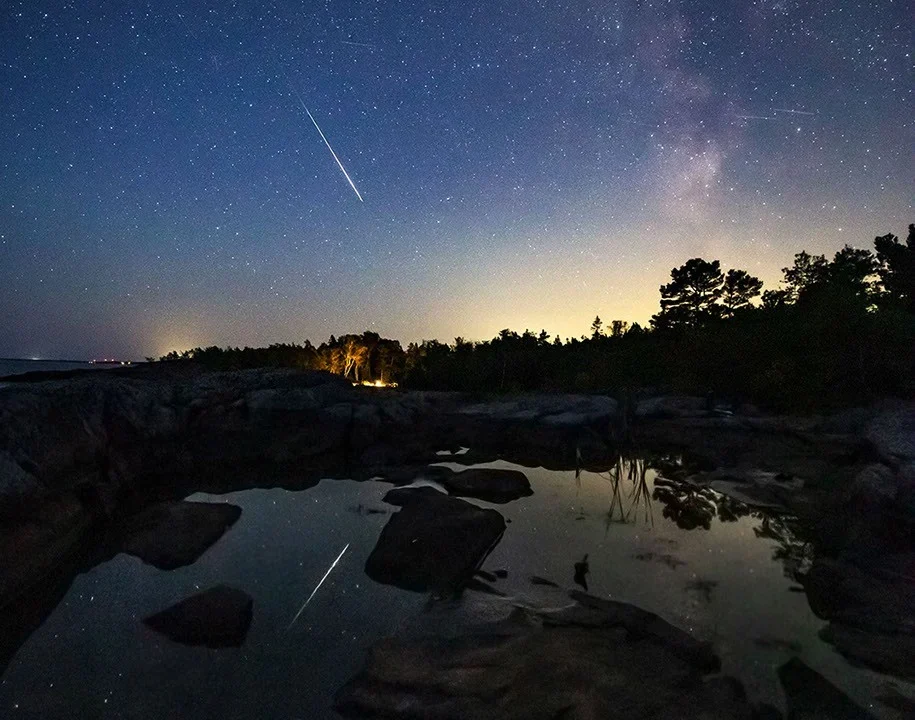
The 2026 Perseid Meteor Shower illuminated the night skies above Sweden with striking brilliance, offering skywatchers a vivid celestial display near the shower’s peak. Captured near the coastal village of Grisslehamn, the imagery features two exceptionally bright Perseid meteors and one shimmering reflection, set against the backdrop of the Milky Way.
What Happened
On August 12, 2026, during the peak of the annual Perseid Meteor Shower, observers near Grisslehamn, Sweden recorded a composite photograph displaying two prominent meteor streaks along with a water reflection. The Perseids originate from dust grains shed by the comet 109P/Swift-Tuttle, which vaporize as they enter Earth’s atmosphere at high speed, creating brief but luminous trails. The timing of the shower’s peak coincided with a New Moon, enabling an optimal dark-sky environment for viewing the meteors without interference from moonlight.
Key Facts
The Perseid meteors appeared radiant from the constellation Perseus, their brightness nearly matching Altair, the brightest star visible in the scene. The image reveals the faint, diffuse glow of the Milky Way across the night sky. The event’s timing was notable as it followed a much-anticipated solar eclipse on the same date, August 12, 2026. The meteor shower is a recurring celestial event, occurring each August as Earth passes through debris along comet Swift-Tuttle’s orbit.
What This Means
The observation of bright Perseid meteors during a new moon represents an ideal conjunction of astronomical factors that enhances public and scientific interest. For casual skywatchers and professional astronomers alike, the absence of moonlight dramatically improves visibility, allowing fainter meteors and the night sky’s intricate features to be seen and captured. This moment also highlights how recurring meteor showers provide accessible opportunities each year for people globally to connect with cosmic events firsthand, fostering greater appreciation for Earth’s place within the solar system.
Moreover, such well-documented observations contribute to ongoing efforts to study the composition and behavior of cometary debris. Understanding the frequency and brightness of meteors aids in modeling the debris fields that may impact Earth and in preparing for potential meteor-related hazards. For communities near coastal and water bodies like Grisslehamn, reflections of meteors add a unique aesthetic dimension, capturing the dynamic relationship between Earth’s surface and the cosmos.
Background
The Perseid Meteor Shower is one of the most prominent annual meteor showers observable from the Northern Hemisphere. It results from Earth crossing the orbit of comet 109P/Swift-Tuttle, which regularly leaves behind dust and small particles. When these particles enter the atmosphere at roughly 59 kilometers per second, they burn up, creating bright streaks in the night sky. Historically, the Perseids have been observed for centuries and remain a popular astronomical event for both amateur and professional skywatchers.
What Comes Next
The Perseid Meteor Shower will continue to return each August, with peak displays varying slightly year to year depending on Earth’s position relative to the comet’s debris trail and the brightness of the moon. Observers can expect similarly favorable viewings in future years when the peak coincides with a new moon or minimal moonlight interference. Upcoming astronomical events, including other meteor showers and eclipses, will offer additional occasions for night sky observation throughout 2026 and beyond.
Sources
This article is based on reporting and publicly available information from the following sources:
Read more Space & NASA stories on Goka World News.