
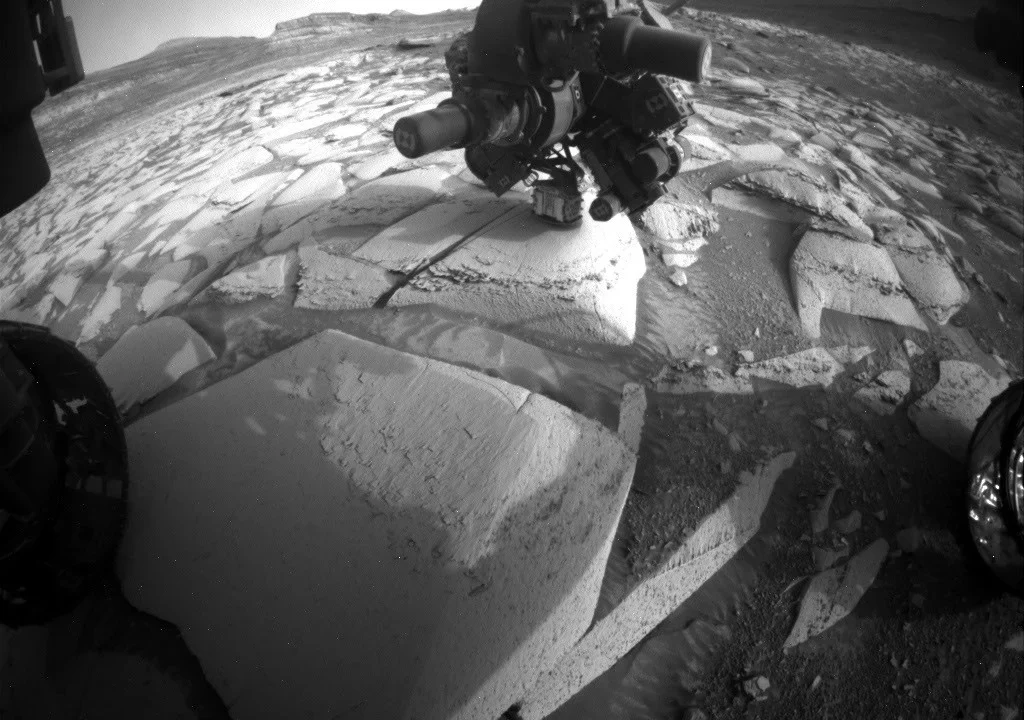
NASA’s Curiosity rover marked its 14th anniversary of landing on Mars by actively conducting scientific investigations at a geologically significant site on Mount Sharp. The mission team celebrated this milestone while the rover continued analyzing rock layers to study Mars’ environmental history.
What Happened
Curiosity landed on Mars on August 6, 2012, and the rover team commemorated 14 years on the Red Planet during the Martian week corresponding to Sols 4975 to 4981. On Sol 4976, the rover’s arm was deployed at the target named “Tunas Khasa” to perform measurements using the Alpha Particle X-Ray Spectrometer (APXS). Throughout the week, Curiosity investigated various rock targets—including “Villarrica,” “Lago Rupanco,” and “Chulipa Punta”—using its suite of instruments such as the Mars Hand Lens Imager (MAHLI), ChemCam, and Mastcam. These analyses focused on the interaction and layering of rocks to understand past water and wind activity on Mars.
Key Facts
The rover’s 46-foot (14-meter) drive positioned it at an area where rock layers intersect and cross-beds are truncated, important clues to the planet’s geological past. During the climb of Mount Sharp, Curiosity experienced inclines up to 24 degrees as it explored these formations. The science instruments involved include APXS for elemental chemistry, ChemCam’s Remote Micro Imager for high-resolution imaging, MAHLI for close-up rock texture imaging, and Mastcam mosaics for layered rock observations. Additional environmental monitoring, such as atmospheric dust, wind, and radiation measurements by the RAD instrument, continued uninterrupted during this period.
What This Means
Celebrating 14 years on Mars highlights Curiosity’s longevity and resilience in conducting sustained, in-depth geological campaigns that have transformed our understanding of the planet’s past environments. The rover’s detailed study of cross-bedded and layered rocks at Mount Sharp provides direct evidence of ancient interactions between wind and water, key factors that shaped Mars’ habitability. For ordinary readers, this ongoing research demonstrates how robotic explorers can piece together the planet’s history over decades, informing both planetary science and future human exploration. These insights also help refine our knowledge about where signs of past life might be preserved on Mars, potentially guiding next-generation missions.
Background
Curiosity launched from Earth on November 26, 2011, aboard an Atlas V rocket and entered Martian orbit before its safe landing in Gale Crater on August 6, 2012. Since then, it has roved thousands of meters, climbing Mount Sharp—a central peak with diverse geological layers that chronicle billions of years of Martian history. The rover’s instruments have previously analyzed sedimentary rocks rich in clay minerals and evidence of ancient freshwater environments, while monitoring radiation and atmospheric conditions.
What Comes Next
The Curiosity team plans to remain at the current location for at least two planning cycles to perform further high-resolution imaging and geochemical analyses on targets such as “Salar de Gorbea,” “Uriondo,” and “Tres Morros.” Upcoming investigations will continue to focus on cross-bedding to unravel sedimentary processes and environmental transitions in Mars’ past. Routine environmental surveys will also persist, including dust devil tracking and cloud monitoring to contextualize current atmospheric conditions against geological findings.
Sources
This article is based on reporting and publicly available information from the following sources:
Read more Space & NASA stories on Goka World News.