
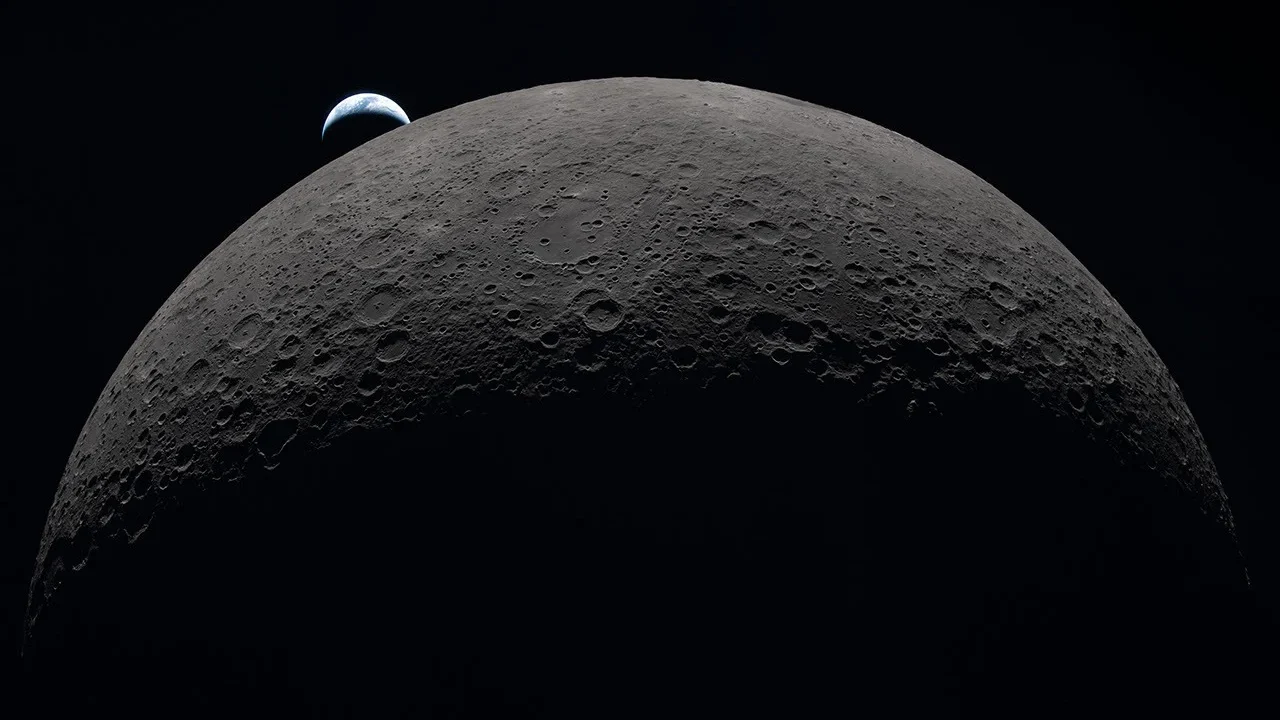
NASA’s Lunar Reconnaissance Orbiter (LRO) has captured a series of detailed images of a new crater on the Moon, created by the impact of a SpaceX Falcon 9 upper stage. This crater formed on August 5, 2025, following the rocket’s launch mission earlier that year. The observations have yielded new measurements and insights about the crater’s dimensions and lunar surface disturbance.
What Happened
Between August 11 and 12, NASA’s LRO adjusted its Narrow-Angle Camera to photograph the Falcon 9 impact site approximately six days after the collision. The crater resulted from the upper stage of the Falcon 9 rocket, which had launched the Firefly Blue Ghost 1 mission in January 2025. The LRO tilted its instruments to aim at the crater during its polar orbit passes about 60 miles (roughly 97 kilometers) above the lunar surface. The spacecraft’s orbit, which circles the Moon every two hours from pole to pole while the Moon rotates beneath, required precise timing and positioning to capture the target crater clearly under multiple lighting conditions.
Key Facts
Analysis of the images reveals the crater is about 60 feet (18 meters) wide and less than 10 feet (3 meters) deep, inferred from shadow length measurements. The Narrow-Angle Camera can resolve features as small as 3 feet (1 meter), allowing scientists to observe the crater rim and the ejecta blanket in detail. The photos display bright rays of fresh material ejected from below the surface near the crater rim, contrasting with darker rays composed of older, weathered dust and rocks that had been exposed to solar wind and micrometeorite impacts over long periods. The impact excavated material from roughly 1.5 feet (0.5 meters) beneath the lunar surface.
Locating the impact site involved extensive coordination. Independent astronomers initially calculated the rocket’s trajectory using publicly available data. NASA’s Center for Near Earth Object Studies (CNEOS) refined these calculations as part of their Planetary Defense program, predicting the impact location. This information was shared with the Republic of Korea’s Danuri spacecraft team, who successfully photographed the crater hours later, confirming the predicted location within 0.6 miles (1 kilometer) accuracy. The Danuri team then provided coordinates back to NASA to optimize LRO’s imaging schedule, allowing LRO to update the crater’s precise center to 19.4759°N latitude, 266.7138°E longitude, at an elevation of 511 meters.
What This Means
This successful observation marks a significant achievement in lunar impact monitoring and shows how multiple international space assets can collaborate effectively to track and analyze artificial impacts on the Moon. Studying such recent craters provides valuable data on how rocket stage collisions affect the lunar surface environment. This, in turn, helps improve models of ejecta distribution and surface weathering processes under the Moon’s unique conditions. For the scientific community, these observations aid ongoing efforts to interpret the Moon’s geological history and refine predictions for future impacts, both artificial and natural.
From a practical standpoint, the validation of trajectory prediction tools by NASA’s Planetary Defense team during this event strengthens Earth’s preparedness for monitoring and responding to potential hazardous objects. Furthermore, the detailed imaging approach demonstrated by LRO, combined with cooperation from other lunar orbiters like Danuri, sets a precedent for future coordinated observations of transient phenomena on the Moon and elsewhere.
Background
The Lunar Reconnaissance Orbiter has been mapping the Moon since its 2009 arrival, providing high-resolution imagery and topographical data crucial for scientific analysis and future mission planning. The mission’s Narrow-Angle Camera has previously documented natural impact craters and artificial disturbances, furthering understanding of impact processes on the lunar surface. The Falcon 9 upper stage was expected to impact the Moon after completing its mission in January 2025, presenting a unique opportunity for direct observation of such an artificial lunar impact.
What Comes Next
Following the detailed imaging and measurement of this crater, NASA and international partners will continue monitoring it to analyze any changes over time. Scientists will further process and compare pre- and post-impact data to enhance understanding of lunar surface dynamics. This event also informs future planning for deliberate lunar impacts aimed at scientific experiments or hazard mitigation strategies.
Sources
This article is based on reporting and publicly available information from the following sources:
Read more Space & NASA stories on Goka World News.