
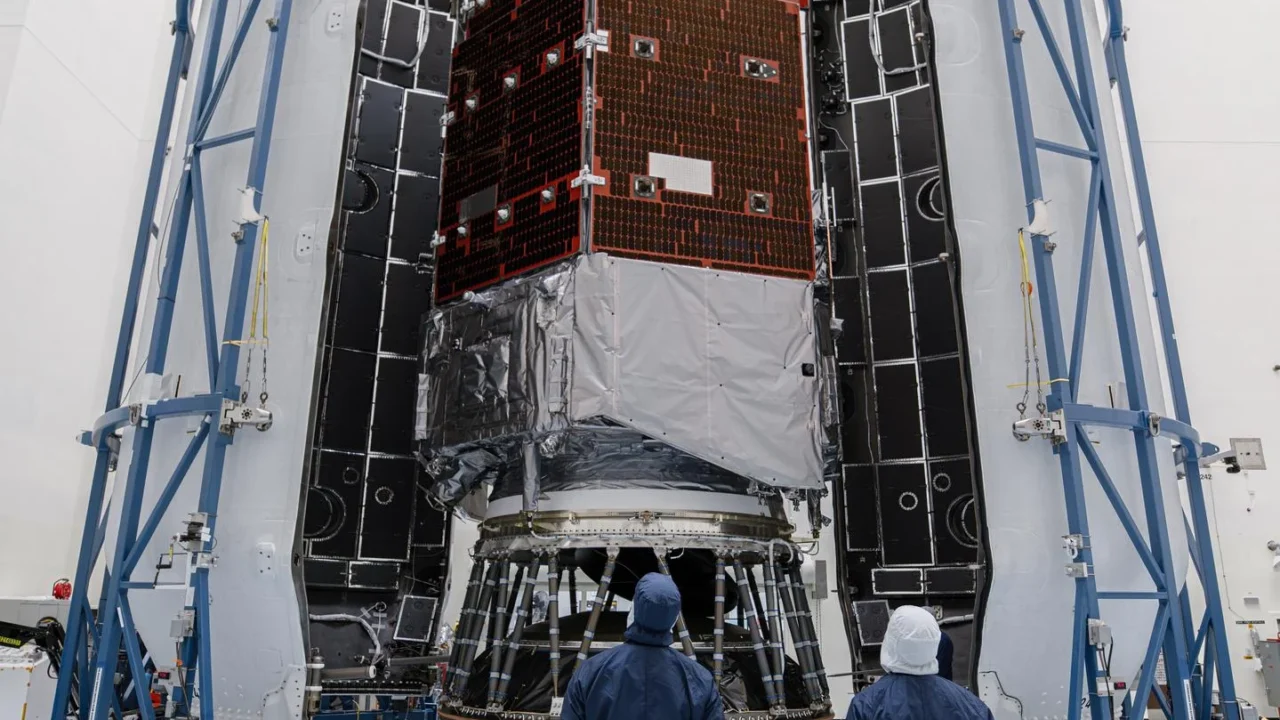
NASA has finalized its coverage plans for the upcoming launch of the Nancy Grace Roman Space Telescope, set to lift off no earlier than 7:26 a.m. EDT on Sunday, August 30. The observatory, NASA’s next-generation space telescope, will launch aboard a SpaceX Falcon Heavy rocket from Launch Complex 39A at Kennedy Space Center in Florida.
What Happened
The Roman Space Telescope mission is preparing for its prelaunch and launch operations with a robust schedule of media events and live streaming starting the day before liftoff. On August 29, NASA will hold a science briefing and prelaunch news conference at Kennedy Space Center to discuss the mission’s objectives and provide detailed information about the telescope’s instruments and launch preparations. The launch coverage will begin in the early hours of August 30, with live video feeds and commentary accessible through NASA’s official platforms.
Following launch and separation from the Falcon Heavy rocket, the Roman Space Telescope will travel to the Sun-Earth Lagrange point 2 (L2), roughly one million miles from Earth. From this vantage, the telescope will conduct a planned five-year primary mission aimed at investigating dark energy, dark matter, exoplanets, and mapping billions of galaxies, with the potential to operate for up to a decade.
Key Facts
The telescope honors NASA’s first chief astronomer, Nancy Grace Roman, and combines sharp infrared imaging with a field of view at least 100 times larger than that of the Hubble Space Telescope. Its advanced instruments include the Roman Coronagraph, designed for exoplanet characterization and direct imaging of nearby planetary systems.
Launch details confirmed by NASA include:
- Launch vehicle: SpaceX Falcon Heavy
- Launch site: Kennedy Space Center, Launch Complex 39A
- Targeted launch date and time: No earlier than 7:26 a.m. EDT, August 30, 2024
- Destination orbit: Sun-Earth Lagrange Point 2 (L2), approximately one million miles from Earth
- Mission duration: Five years primary, with a goal of ten years
- Mission management: NASA Goddard Space Flight Center with participation from JPL, Caltech/IPAC, Space Telescope Science Institute, and international partners including ESA, JAXA, CNES, and the Max Planck Institute
NASA will provide extensive launch-day communications, including an audio-only broadcast and livestream with countdown milestones, and stream postlaunch news conferences. Virtual attendance options for the public are also available.
What This Means
The Roman Space Telescope represents a major leap in astronomy and astrophysics, with its expansive field of view allowing scientists to capture sweeping surveys of the cosmos efficiently. Unlike Hubble, which focuses on narrow deep-field images, Roman’s ability to survey vast areas promises groundbreaking insights into the nature of dark energy and dark matter, components that constitute most of the universe yet remain poorly understood.
This mission’s capability to discover and analyze exoplanets using cutting-edge coronagraph technology could transform our understanding of planetary systems beyond our own. For the scientific community and the public, Roman’s data will be openly accessible, fueling decades of research and potentially leading to discoveries that reshape our grasp of cosmic history, galaxy formation, and the fundamental forces driving the universe.
Furthermore, launching on a SpaceX Falcon Heavy underscores the increasing partnership between NASA and commercial launch providers, reflecting the evolving dynamics of how flagship scientific missions reach space.
Background
The Roman Space Telescope follows in the footsteps of Hubble and the James Webb Space Telescope but with a unique mission profile centered on wide-field infrared observations. Named after Nancy Grace Roman, who laid the foundation for NASA’s space astronomy program, this telescope has been in development for over a decade. It integrates contributions from international space agencies and instrumentation specialists to survey the cosmos with unprecedented breadth and sensitivity.
What Comes Next
After launch, mission teams will monitor Roman’s transit to L2 and initiate instrument calibration before beginning scientific operations. NASA plans ongoing updates through official blogs, news conferences, and social media channels, keeping the public informed as Roman begins unraveling the mysteries of the universe.
Sources
This article is based on reporting and publicly available information from the following sources:
Read more Space & NASA stories on Goka World News.