
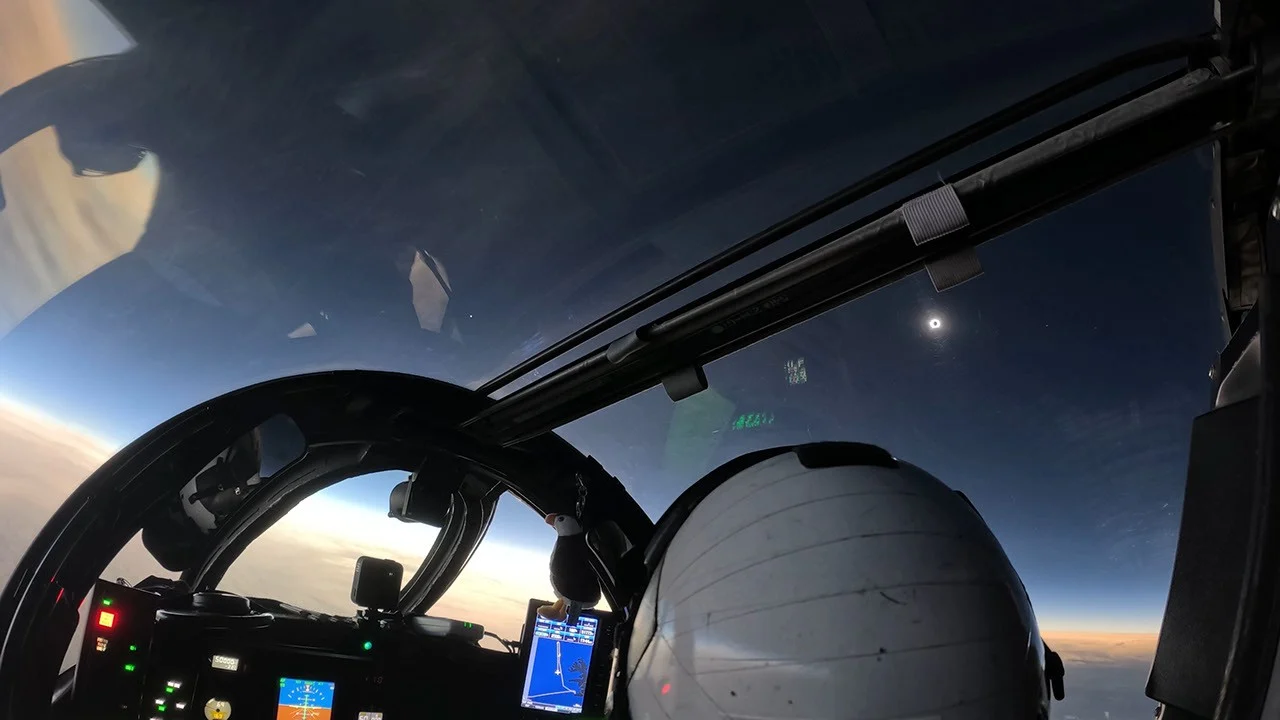
NASA’s WB-57F high-altitude research aircraft conducted a specialized mission on August 12, 2026, to chase and capture the moment of a total solar eclipse over the North Atlantic near Iceland. Flying at an altitude of 50,000 feet, the plane was precisely navigated along the path of totality—the region where the Moon completely blocks the Sun—to maximize observation time of the eclipse’s most dramatic phase.
What Happened
On August 12, NASA deployed its WB-57F research aircraft off the coast of Iceland, tasked with recording the 2026 total solar eclipse from above atmospheric disturbances. By flying within the narrow “path of totality,” where the Sun is fully obscured by the Moon, the plane’s crew captured clear images of the solar corona—the Sun’s extended outer atmosphere visible only during totality. The mission’s strategic flight allowed observation beyond clouds, dust, and water vapor that normally hinder ground-based eclipse viewing. The footage includes views from the cockpit showing the darkened sky during totality, with bright Venus visible to the left, and Jupiter and Mercury faintly visible near the eclipsed Sun.
Key Facts
The WB-57F operated at about 50,000 feet altitude, above much of Earth’s atmosphere, enabling unobstructed observations. The aircraft was piloted along the confirmed path of totality to extend the time it remained in the Moon’s shadow. Onboard cameras provided high-resolution eclipse data, avoiding typical ground-based atmospheric interference. The eclipse’s sky appeared dark in the shadowed area while remaining bright along the horizon outside the Moon’s shadow. The observation location near Iceland offered a unique vantage point for this August event, verified by NASA’s official Astronomy Picture of the Day (APOD) release.
What This Means
This airborne observation of the solar eclipse demonstrates how high-altitude platforms like NASA’s WB-57F can significantly enhance eclipse studies by surpassing atmospheric limitations. Such clarity offers scientists more precise data on solar phenomena like the corona, which is crucial for understanding solar wind and its effects on space weather impacting Earth’s technology and satellites. Additionally, capturing planetary alignments near the eclipsed Sun, including Venus, Jupiter, and Mercury, helps refine solar system models and celestial navigation techniques. For the public, these images provide a rare and vivid perspective of an eclipse from above the clouds, deepening appreciation of celestial events often obscured from ground observation.
Background
The WB-57F, a modified high-altitude research plane, has been used by NASA for decades to study atmospheric and astronomical phenomena beyond typical commercial flight altitudes. Previous missions have included observing solar eclipses, auroras, and other transient events. Total solar eclipses occur when the Moon’s apparent diameter fully blocks the Sun, casting a shadow on Earth’s surface; the path of totality is narrow and fleeting. Flying along this path prolongs observation time compared to stationary ground observations, which can only capture a few minutes of totality.
What Comes Next
NASA will continue to utilize high-altitude aircraft for eclipse and celestial event observations when conditions allow, planning future missions in coordination with predicted eclipse paths. Data collected will undergo detailed analysis to improve models of the solar corona and atmospheric effects, advancing space weather forecasting and solar science.
Sources
This article is based on reporting and publicly available information from the following sources:
Read more Space & NASA stories on Goka World News.