
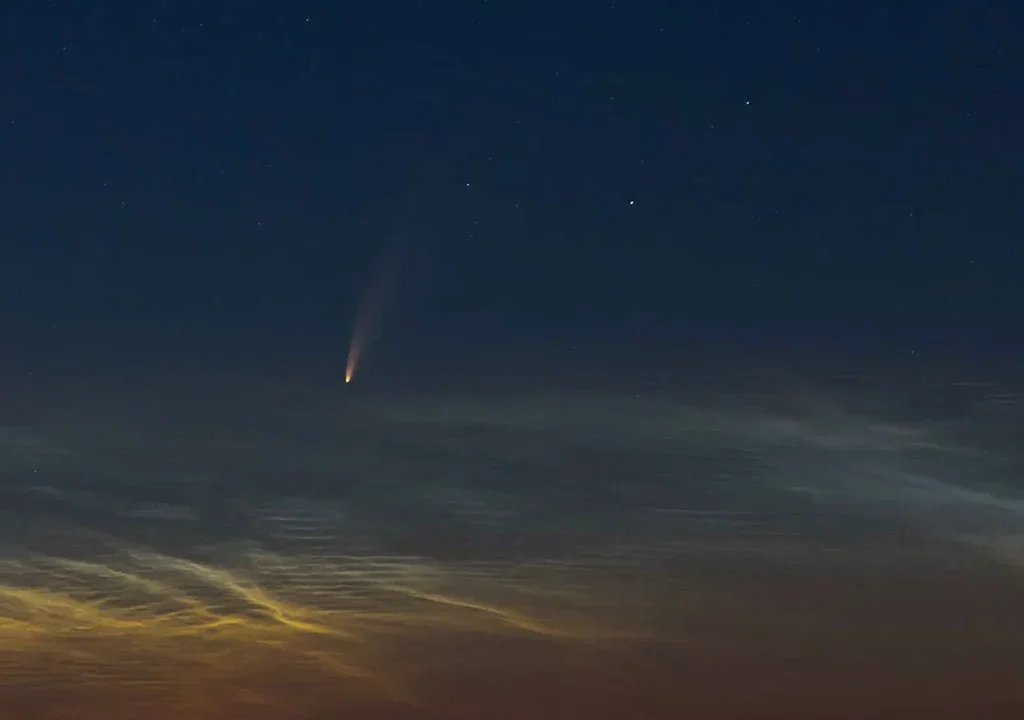
A captivating time-lapse video taken from Italy on July 8, 2026, vividly captures Comet C/2020 F3 (NEOWISE) rising over the Adriatic Sea shortly before dawn. This rare event, witnessed by early risers, presents one of the few comets visible to the naked eye this century, highlighting NEOWISE’s enduring brightness and remarkable tail structure.
What Happened
On the morning of July 8, 2026, an observer in Italy documented Comet NEOWISE ascending above the Adriatic Sea horizon just before sunrise. Over a period of 30 minutes, over 240 images were taken and compiled into a dynamic time-lapse that displays the comet’s movement through a foreground of bright, undulating noctilucent clouds. Behind the comet, a starry sky frames the scene, enhancing the visual impact of this inner Solar System visitor. The comet’s ion and dust tails emanate clearly, emphasizing its complex and bright appearance that lasted unexpectedly long after its 2020 discovery.
Key Facts
Comet NEOWISE, officially designated C/2020 F3, was first identified in March 2020 and quickly became known as the “Great Comet of 2020” due to its brightness and visibility. The nucleus of the comet measures approximately five kilometers in diameter, from which the bright ion and dust tails extend. The featured time-lapse video—composed of more than 240 separate frames captured over half an hour—was produced by photographer Paolo Girotti. The observations occurred over the Adriatic Sea, with the comet rising through noctilucent clouds, a rare type of high-altitude cloud visible just before dawn or after sunset.
What This Means
This remarkable visual record of Comet NEOWISE serves as a testament to how transient celestial phenomena can captivate observers and contribute to public interest in astronomy. The comet’s continued brightness over an extended period provided both professional astronomers and the general public an accessible opportunity to witness and study an active comet with notable ion and dust tail structures. Such observations help scientists better understand comet composition, behavior near the Sun, and interactions with solar wind, enriching the broader knowledge of small Solar System bodies. For the public, events like this ignite curiosity about space, fostering a connection with the cosmos beyond daily life.
Background
Discovered by NASA’s Near-Earth Object Wide-field Infrared Survey Explorer (NEOWISE) space telescope in 2020, Comet NEOWISE offered a rare spectacle as one of the brightest comets to appear in the Northern Hemisphere during this century. It remained visible to the naked eye for over a month in mid-2020, thanks to its robust nucleus and the extensive tails formed by dust and ionized gases shed as it approached the Sun. This latest 2026 sighting demonstrates the comet’s continued orbital journey within the inner Solar System, retaining enough brightness to be photographed vividly.
What Remains Unclear
The long-term evolution of Comet NEOWISE’s activity as it continues on its orbit remains under observation. Researchers are yet to fully analyze recent imaging data to assess any changes to its tail structure, nucleus activity, or dust emissions since 2020. Whether the comet will remain visible in future perihelion passages depends on its physical evolution and external solar environment.
Sources
This article is based on reporting and publicly available information from the following sources:
Read more Space & NASA stories on Goka World News.