
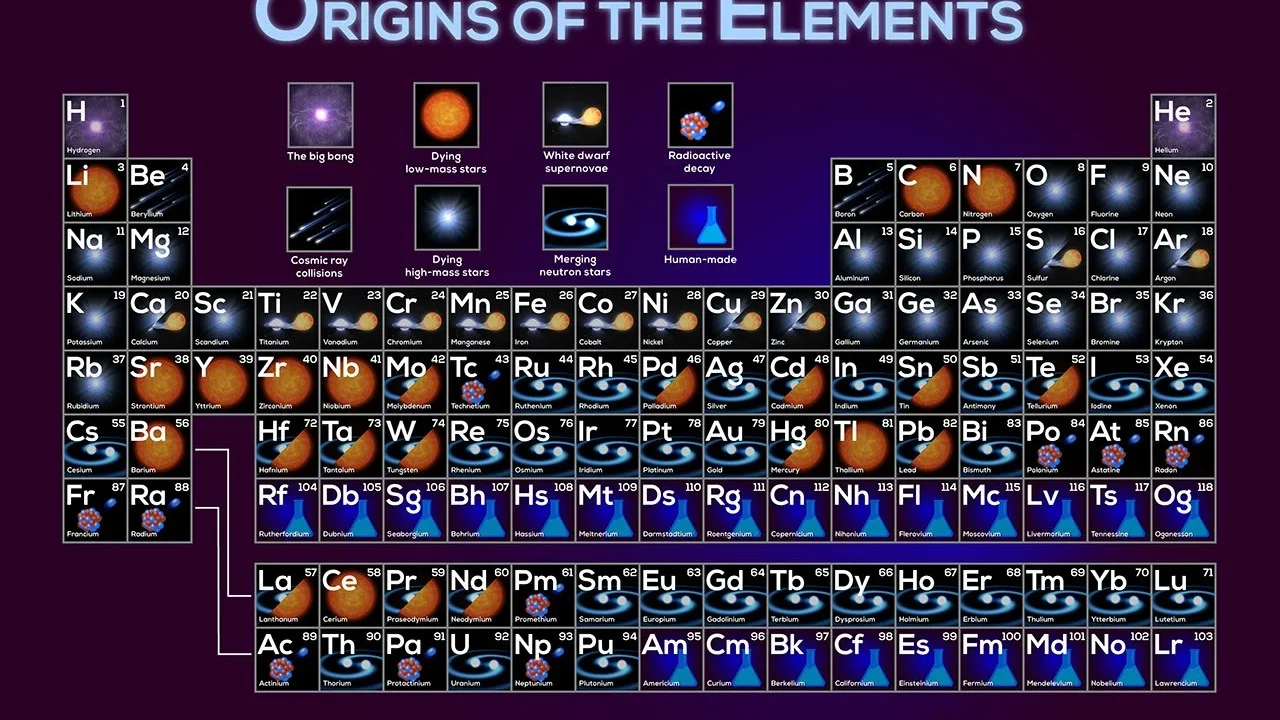
The hydrogen, carbon, oxygen, iron, and even gold found in the human body trace their origins back to dramatic events in the universe’s history, according to a NASA Astronomy Picture of the Day (APOD) feature. This visual explanation highlights how the building blocks of life and matter were forged across cosmic time through processes ranging from the Big Bang to stellar deaths and collisions.
What Happened
NASA’s APOD showcased a color-coded periodic table illustrating humanity’s current understanding of the astrophysical sources of elements. It explained that all hydrogen in the universe, including that in the human body and water molecules, originated in the Big Bang—the universe’s explosive beginning about 13.8 billion years ago. Elements such as carbon and oxygen were synthesized inside the cores of stars through nuclear fusion processes during their lifetimes. Iron found in our bodies was primarily produced in supernova explosions, the violent deaths of massive stars. The rare but valuable element gold was likely formed in collisions between neutron stars, events that may have been detected as short gamma-ray bursts or gravitational wave signals. Other essential trace elements like phosphorus and copper are still under study, as their exact astrophysical origins remain less well understood.
Key Facts
The APOD image highlighted the following confirmed scientific details:
- Hydrogen is exclusively from the Big Bang, with no other significant cosmic production sources.
- Carbon and oxygen are products of stellar nuclear fusion within the interiors of stars.
- Iron mainly originates from material expelled by supernova explosions during the lifecycle of massive stars.
- Gold likely forms during neutron star mergers, linking exotic astrophysical phenomena to terrestrial precious metals.
- Some element origins, such as copper’s nuclear formation sites, are still subjects of active research involving observations and modeling.
What This Means
Understanding the cosmic origins of elements deepens our appreciation of how intimately connected human life is to the broader universe. The fact that the atoms in our bodies were created in distant stars and violent cosmic collisions highlights the continuity between cosmic evolution and biological life. This insight illuminates the intricate processes that made Earth’s chemistry—and life itself—possible. Moreover, recognizing the ongoing uncertainty around certain elements underscores the dynamic nature of astrophysics as it continues to uncover the universe’s elemental history. For the public, these revelations reinforce the idea that studying space is not just about faraway worlds, but about understanding our own existence at a fundamental level.
Background
The story aligns with a long tradition of astrophysical research tracing element formation, known as nucleosynthesis. The Big Bang produced primarily hydrogen and helium, while stellar nucleosynthesis in star cores gradually created heavier elements. Subsequent explosive events like supernovas further enriched the cosmos with elements essential for planets and life. Recently, gravitational wave detections of neutron star collisions have confirmed a major site for producing even heavier elements such as gold. NASA’s APOD series regularly highlights themes that connect astronomy with fundamental scientific knowledge accessible to the public.
What Remains Unclear
While the broad strokes of element origins are well established, certain details remain uncertain. For instance, the precise astrophysical processes and environments producing elements like copper and others in smaller quantities are still under investigation. Ongoing observational campaigns and computational models aim to resolve these open questions about nucleosynthesis pathways, improving our understanding of cosmic chemical evolution.
Sources
This article is based on reporting and publicly available information from the following sources:
Read more Space & NASA stories on Goka World News.