
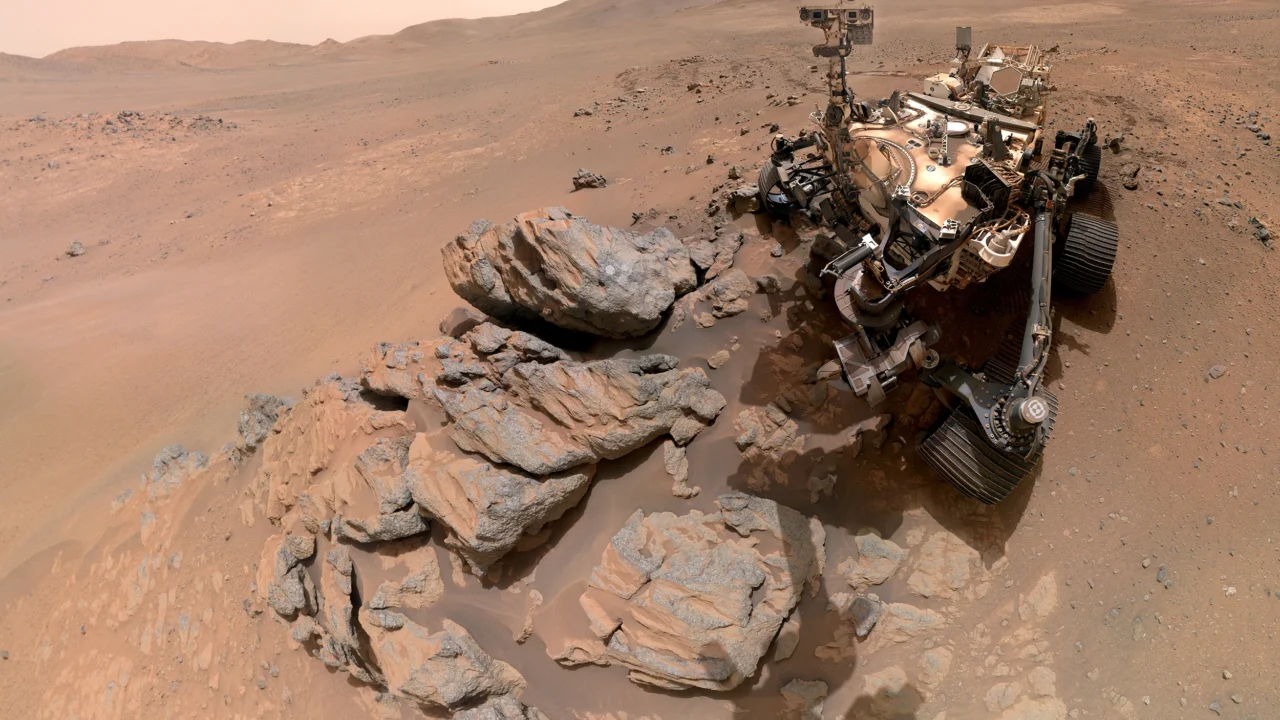
NASA’s Perseverance rover recently captured a detailed self-portrait at a Martian site known as “Lac de Charmes” while conducting rock analysis near Jezero Crater.
The selfie, created by stitching together 61 individual images, shows Perseverance with its mast focused on a rugged rock outcrop in the foreground. The rover used its abrasion tool to grind into the rock surface, producing a circular patch revealing the material beneath the weathered exterior for scientific examination. This technique helps researchers study Mars’ geology by accessing fresh rock surfaces.
The photograph was taken on March 11, corresponding to the rover’s 1,797th Martian day (sol) on the Red Planet. At this point in its mission, Perseverance had ventured its farthest west beyond the central area of Jezero Crater, an ancient lakebed thought to be a promising site for discovering signs of past microbial life.
The selfie offers a sweeping view of Jezero Crater’s western rim extending across the background, providing context to the rover’s exploration zone as it continues its search for clues about Mars’ habitability and geological history.
Why it matters
Perseverance’s abrasion technique is central to its scientific goals, enabling the collection of fresh rock samples for analysis by onboard instruments and future sample return missions. The location near Jezero Crater remains a high-priority area for astrobiology and planetary science because of its ancient lacustrine environment.
Background
Since landing in February 2021, Perseverance has traversed various terrains in Jezero Crater, tasked with investigating Mars’ climate, geology, and potential biosignatures. The rover carries advanced instruments for imaging, chemical analysis, and sample collection, marking the latest phase of Mars exploration following earlier successful missions. Its progress westward within the crater extends its scientific range and contributes to understanding the planet’s complex history.
Sources
This article is based on reporting and publicly available information from the following source:
Read more Space & NASA stories on Goka World News.