
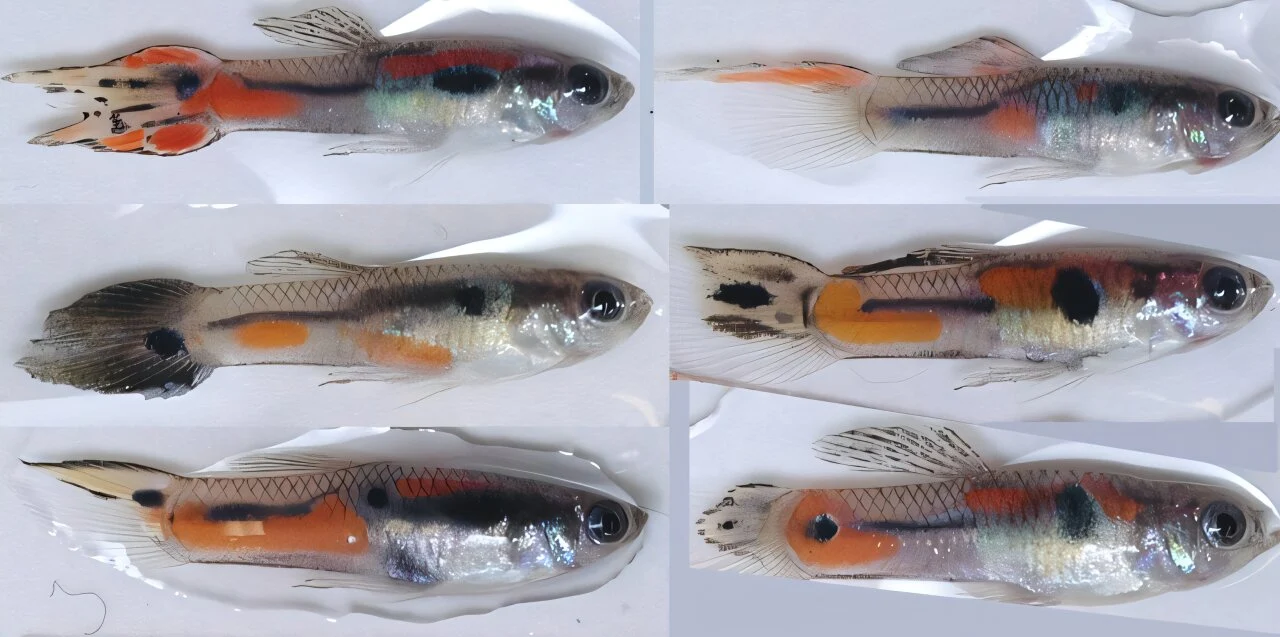
New research published in Philosophical Transactions B sheds light on why female guppies (Poecilia reticulata) tend to select males with rare or novel coloration patterns. This preference, known as negative frequency-dependent selection, gives rare males a mating advantage, which fluctuates as their traits become more or less common. Evolutionary biologists Mitchel James Daniel of Florida State University and F. Helen Rodd of the University of Toronto offer a comprehensive review that may help explain the persistence of genetic diversity in guppies and potentially other species.
What Happened
Daniel and Rodd analyzed decades of research including laboratory experiments, field studies, and long-term trait tracking in wild guppy populations. They focused on why female guppies show a consistent preference for males that display unusual color morphs, which vary extensively across individuals. Their findings, published in 2026, argue that habituation—a psychological phenomenon whereby repeated exposure to a stimulus reduces responsiveness—plays a key role. Females surrounded by many males exhibiting common orange spots gradually tune out this visual pattern, making males with uncommon markings, such as blue or black spots, stand out and catch their attention.
Key Facts
The review underlines that female preference for rare male morphs in guppies is a “real and robust phenomenon,” supporting the concept of negative frequency-dependent selection. This means that a male’s likelihood of mating success is inversely related to how common his coloration pattern is in the population. The researchers cite extensive empirical evidence from multiple independent studies that document this selective behavior over successive generations in natural habitats across Trinidad. The variety among male guppies is notable, with essentially no two exhibiting identical color patterns, illustrating extreme genetic polymorphism. The authors also explored alternate theories such as inbreeding avoidance or predator-driven selection but found habituation to be a particularly persuasive mechanism.
What This Means
This research provides important insights into how behavioral preferences can maintain biodiversity within a species. The finding that females focus more on rare visual traits due to habituation highlights a dynamic balance that sustains genetic polymorphism in guppies. Such diversity can be advantageous for populations, enhancing resilience to environmental changes and disease by preserving a broad genetic base. Beyond guppies, this study suggests that habituation-driven preference for rare individuals might influence sexual selection in other species exhibiting high variability. Recognizing the role of sensory processing in mate choice expands our understanding of evolutionary pressures beyond simple survival and reproduction metrics, emphasizing complex cognitive factors in natural selection.
Background
The phenomenon of negative frequency-dependent selection has been theorized to explain how multiple phenotypes persist within populations rather than one dominant type becoming fixed. Guppies, with their vivid and variable male color patterns, serve as an exemplary model organism. Prior work has identified female preference for novel traits but lacked consensus on the underlying cognitive or evolutionary drivers. The habituation concept applies psychological principles to evolutionary biology, illustrating how sensory perception and neural responses can directly influence mate choice and hence evolutionary trajectories.
What Remains Unclear
While habituation is strongly supported, Daniel and Rodd acknowledge that multiple evolutionary forces may simultaneously influence female preferences, including predator avoidance and genetic compatibility. Additionally, the degree to which this preference operates uniformly across guppy populations in varying ecological contexts remains to be fully characterized. Further empirical studies are needed to experimentally isolate habituation effects and confirm their primacy over other selection pressures.
What Comes Next
The authors recommend future research to experimentally manipulate male phenotype frequencies while monitoring female behavioral responses, to more precisely quantify habituation impacts. Exploration of neural mechanisms underlying habituation in guppy mate choice could also clarify cognitive contributions to sexual selection. Investigating similar phenomena in other species will help determine how widespread this mechanism is in nature.
Sources
This article is based on reporting and publicly available information from the following source:
Read more Science Discoveries stories on Goka World News.