
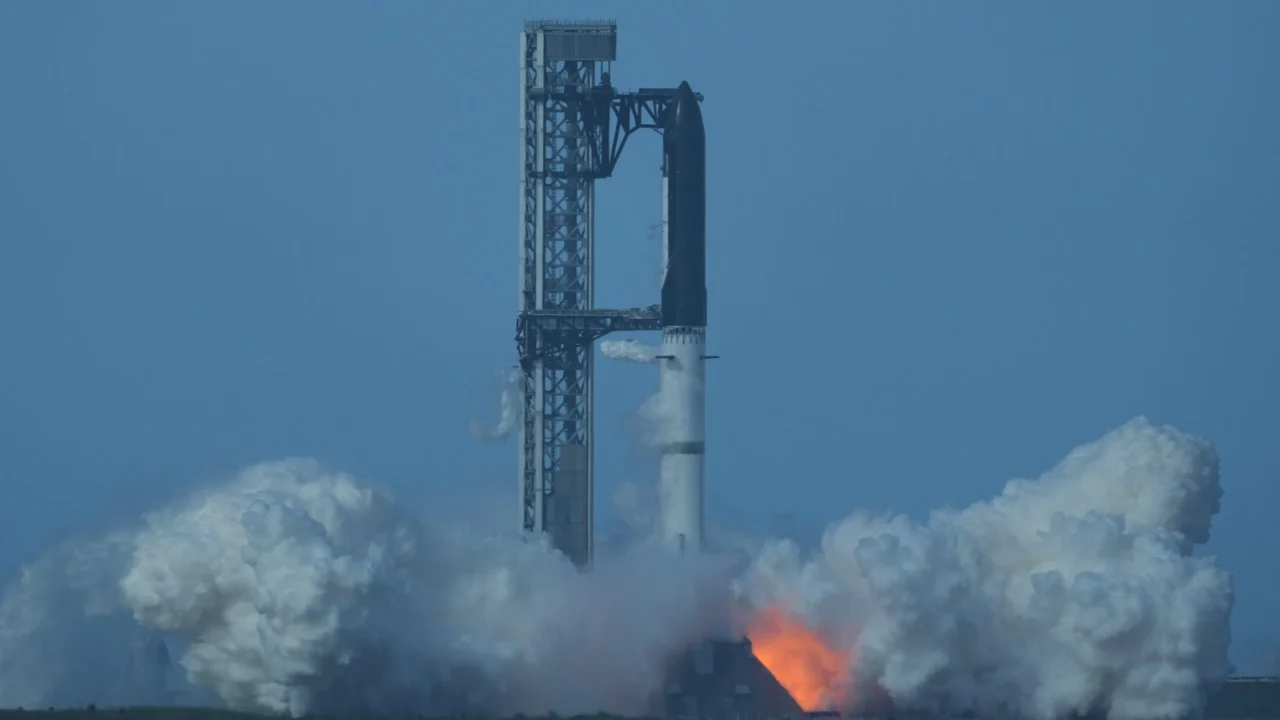
SpaceX’s towering Starship rocket, renowned as the world’s largest and most powerful launch vehicle, aborted its test flight mere seconds before liftoff on July 16, 2026. The rocket encountered a last-minute engine ignition failure that prompted an automatic abort to maintain safety and prevent a potentially catastrophic launch.
What Happened
The 407-foot-tall Starship, featuring 33 main engines, was set for its 13th flight from SpaceX’s Starbase facility near the Texas-Mexico border. Approximately three seconds before the scheduled liftoff, engine ignition began but failed to fully commence. Onscreen data during the company’s webcast showed that four engines did not ignite, leading the remaining 29 engines to immediately shut down. This unprecedented last-second abort kept the massive rocket firmly anchored to the launch pad.
Following the abort, the launch team quickly commenced draining the rocket’s fuel to ensure safety. SpaceX CEO Elon Musk announced via the social platform X that two engines would be replaced to “be confident of a good flight” before rescheduling. He indicated that a probable launch attempt would occur early the following week.
Key Facts
The Starship rocket stands 407 feet (124 meters) tall and is powered by 33 main engines, making it the most powerful rocket currently in operation worldwide. The launch was a critical step toward SpaceX’s goal of space-skimming globe-circumnavigation. Notably, this mission carried twenty of SpaceX’s latest Starlink satellites designed to communicate with existing units in orbit and to capture imagery of the rocket’s heat shield during flight.
Neither the spacecraft nor the booster stage were intended to be recovered on this mission, with plans for both to be expended into the ocean at flight’s end. Weather conditions were favorable, further highlighting that the engine ignition issue was the sole cause of the abort.
What This Means
The last-second abort underscores the complexity and risk inherent in launching a rocket as large and sophisticated as Starship. Despite its size and power, the vehicle’s automated systems correctly identified a fault in engine ignition and halted the launch, preventing a potentially dangerous failure. This incident illustrates how critical redundant safety mechanisms are in aerospace operations.
Starship’s role extends beyond its massive scale; NASA relies on it for upcoming lunar missions under the Artemis programme. SpaceX is developing Starship as a lunar lander to ferry astronauts to the moon, requiring precise and reliable launches in the near future. Delays or technical setbacks like this engine failure emphasize the ongoing challenges facing commercial spaceflight providers as they transition to more ambitious, crewed lunar operations.
For the public and the space industry, the abort reminds observers that although SpaceX has made significant strides, the path to routine, safe, and reliable heavy-lift launches remains technically demanding and subject to setbacks. Reassuringly, the vehicle’s automatic abort system worked as intended, highlighting engineering safeguards that protect both hardware and personnel.
Background
SpaceX’s Starship rocket has undergone multiple test flights, some of which ended explosively due to complex flight or landing system failures. Each iteration provides critical data to refine the vehicle’s design and operational procedures. NASA has contracted both SpaceX with Starship and Jeff Bezos’ Blue Origin to develop lunar landers aimed at returning humans to the moon for the first time in over 50 years.
Artemis III, scheduled for no earlier than 2027, will require docking practice in Earth orbit with Starship or other lunar landers, followed by a lunar surface mission. Artemis IV, planned for 2028 or later, intends to deploy astronauts to the moon’s south pole using these methods.
What Comes Next
SpaceX plans to replace the two malfunctioning engines and conduct a new launch attempt early the following week. The company will closely monitor engine performance and other parameters critical to certifying Starship for its lunar role. Further test flights are expected as SpaceX moves toward operational status aligned with NASA’s lunar mission timelines.
Sources
This article is based on reporting and publicly available information from the following source:
Read more Space & NASA stories on Goka World News.