
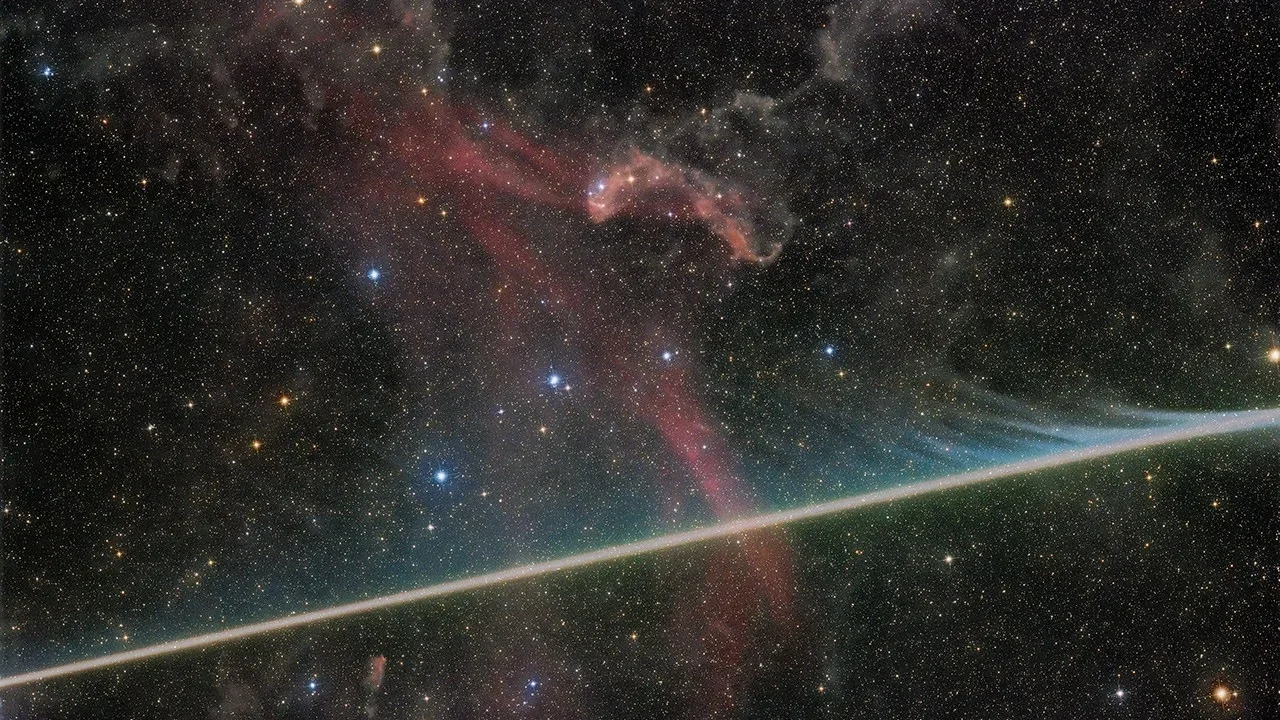
A striking photograph taken from Nevada’s Death Valley Observatories last month captured a bright meteor vividly streaking across the night sky near the Great Lacerta Nebula. The meteoroid, likely a small pebble-sized object, briefly illuminated Earth’s atmosphere before vaporizing, leaving colorful traces that reveal details about its composition.
What Happened
During a long exposure image session focused on the Great Lacerta Nebula, a faint red emission nebula located in the constellation Lacerta, a bright meteor unexpectedly appeared and disappeared. This meteor, caused by a tiny meteoroid entering Earth’s atmosphere at high speed, heated and excited surrounding air molecules, producing a brilliant glow. As it vaporized fully, the meteor left behind a trail of gas and dust, whose colors provide clues to the elements contained in the meteoroid. The image was captured from Death Valley Observatories in the United States in late July 2026.
Key Facts
The photograph showcases the meteor transiting the atmosphere while the Lacerta Nebula glows faintly in red near the image’s center. At the time, several meteor showers were concurrently active, including the Perseids, which are known for their high frequency of meteors. The vibrant glow of a bright gibbous Moon, however, was competing with the meteor displays for sky visibility. The Perseids shower, which peaks in about ten days, will benefit from the Moon becoming less bright, coinciding with a new Moon and a total solar eclipse visible from some regions.
What This Means
This image illustrates how meteoroids, even tiny pebble-sized ones, interact dynamically with Earth’s atmosphere, presenting astronomers with real-time data on their compositions through optical emissions generated during vaporization. Such observations are valuable for understanding the origins and makeup of debris entering our atmosphere, enriching knowledge about the ongoing influx of cosmic material impacting Earth.
For the public, this also highlights the opportunities to witness spectacular natural light shows—the meteor showers—especially when lunar brightness conditions are favorable. Events like the upcoming Perseids offer some of the best chances yearly to see fleeting meteor activity firsthand. Capturing meteors alongside deep-sky objects like the Lacerta Nebula also underscores how wide-field astrophotography can reveal multiple layers of cosmic activity in a single frame.
Background
The Great Lacerta Nebula is an emission nebula positioned in the faint constellation Lacerta. It is characterized chiefly by glowing hydrogen gas that emits in red wavelengths. Meteor showers such as the Perseids occur when Earth passes through debris trails left by comets, producing multiple meteors per hour under ideal dark sky conditions. Death Valley Observatories is a known location for astrophotography due to its low light pollution and clear skies.
What Comes Next
Skywatchers can anticipate the peak of the Perseids meteor shower in early August, when the Moon will be near new phase, greatly enhancing meteor visibility. Additional observational campaigns from professional and amateur astronomers will likely capture more meteors and other celestial phenomena leading up to and during this peak period.
Sources
This article is based on reporting and publicly available information from the following sources:
Read more Space & NASA stories on Goka World News.